
Congress Mishandling a Load of Manure from the National Pork Lobby
There is the stink of foreign influence in Congress as some lawmakers seek to boost international factory farm interests by overturning the will of American voters.
- Wayne Pacelle
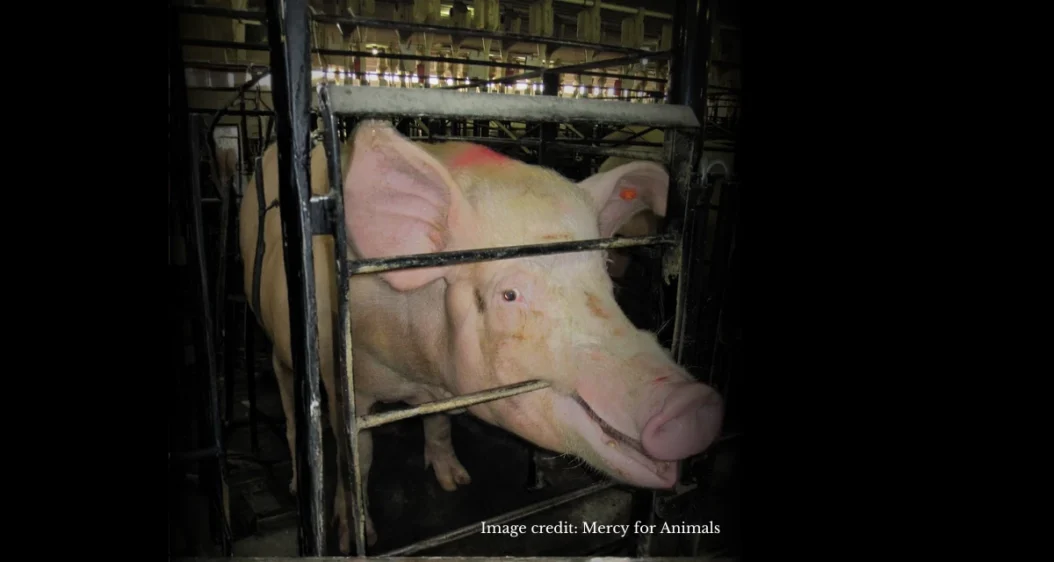
The National Pork Producers Council (NPPC) has shoveled a load of pig slop to a handful of farm-state lawmakers in Congress in promoting the Save Our Bacon (SOB) Act. This special interest group, dominated by China’s Smithfield Foods and Brazil’s JBS, is falsely telling federal lawmakers that the pig industry is in crisis because two states are limiting the sale of pork from factory farms that immobilize breeding sows in 2-by-7-foot metal cages.
Rather than critically examining this false narrative, a couple dozen federal lawmakers are charging ahead with their so-called SOB Act and trying to overturn Proposition 12 and Question 3 — and the will of millions of voters in California and Massachusetts.
Their SOB Act is now in the House Farm bill, likely headed to the floor for consideration sometime in April.
Funded by the NPPC and its surrogates, the lawmakers very actively promoting the SOB Act deserve some tough questions sent their way.
- Why are they heeding the demands of a trade association dominated by two foreign-owned companies that together control 40% of domestic production of pork in America? No sector of American agriculture has anything close to this level of foreign control, and the level of control exhibited by the Chinese Communist Party should be setting off alarm bells within the GOP.
- What happens to the thousands of American farmers who collectively invested billions in more extensive, more humane housing for breeding sows if the SOB Act passes and Smithfield and JBS flood the market with their cheap, factory-farmed pork?
- Why are they not taking into account the ballot measures and legislative activity that has produced bans on gestation crates in 11 states? And why are they ignoring the public pronouncements from McDonald’s, Costco, Walmart, Cracker Barrel, and 50 other major food retailers in opposition to gestation crates?
The Pig Industry is Flourishing in the Era of Prop 12 and Question 3
I’ve just reviewed a report in The National Hog Farmer, and it tells a very different story from the alleged crisis caused by California’s Prop 12 and Massachusetts’ Question 3.
According to a University of Missouri agricultural economist, the U.S. hog industry is profitable and growing. The expert noted that Iowa farrow-to-finish operations have been profitable for 23 consecutive months. Analysts expect the upcoming hog inventory report to show modest growth across all weight categories, with summer slaughter projected to rise by about 2.3% year-over-year.
The pig industry is not in “chaos,” as the chairman of the House Agriculture Committee falsely claims.
There is no “coercion” of Iowa pork farmers to comply with the California law.
And there has been no surge in national pork prices — the NPPC’s most persistent scare tactic. The average retail price of pork in February was $4.90 per pound, just pennies above a year ago.
For those farmers who wish to continue to rely on extreme confinement of sows, they have 48 states, five territories, and 139 countries where they can sell pork from immobilized pigs. In all, there are 192 of 194 markets fully available to them.
The NPPC’s argument is about ideology — and has not a thing to do with practical pig-farming concerns. The truth is, hog production has always been heterodox, just like the marketplace of consumers.
California has now certified more than 1,300 Prop 12-compliant suppliers and distributors. Approximately 27% of U.S. pork producers have made or are making investments to comply with Prop 12, according to USDA. These farmers and businesses are successfully serving a major market while meeting basic animal welfare standards. And they are profiting from that market.
The NPPC’s ability to make its case for repealing Prop 12 and convincing voters, federal judges, and all but a small subset of federal lawmakers to heed its wishes has not been impressive. Quite the contrary.
- The NPPC and its surrogates have come out on the losing end in five out of five ballot measures that took the question of gestation crate confinement to the voters.
- They have now lost 23 consecutive federal court cases challenging these laws, including a case that wound its way to the conservative U.S. Supreme Court.
- And their prior maneuvers to preempt state farm animal welfare laws on the 2014 and 2018 Farm bills both went down in flames.
Two Major Sectors of Animal Agriculture Diverge
Years ago, the United Egg Producers spent millions fighting California’s Prop 2, the antecedent to Prop 12 that ended the use of gestation crates, battery cages for hens, and small crates for veal calves. The egg industry trade association partnered with the NPPC to fight Prop 2 and both trade groups took it on the chin when voters approved the humane housing standards in a landslide.
But the UEP reacted very differently than the NPPC to that election outcome. The UEP heeded the voters’ decision. Its executives and its board members realized that their customers don’t much like battery cages. They decided to cooperate with animal welfare groups and to slowly but steadily shift production in the direction of cage-free housing, as long as markets were available to them.
The egg industry explicitly told farm-state lawmakers it does not want state laying-hen welfare laws rolled back by Congress. Those laws are important to major egg producers, because they provide markets to the large and growing share of cage-free producers. The Save Our Bacon Act — formerly the EATS Act, which included a preemption of state laws restricting the sale of eggs from caged hens — now omits any mention of the egg industry.
The Save Our Bacon Act is today all about the NPPC and its major foreign-owned companies that dominate domestic pig production.
In fact, not one other sector of agriculture has any practical stake in this legislation – not any other sector of animal or plant agriculture, either. Any expression of support for the NPPC and its SOB Act by farm groups is an act of solidarity, not a matter of business for the rest of the agriculture sector.
The principle that the states should not be allowed to limit in-state agricultural commerce is a policy concept left for dead by Congress. The SOB Act is a special interest gift to foreign-owned pig companies financing the multimillion-dollar campaign to overturn American elections.
We will not stand by while Congress attempts to nullify the will of American voters in landslide elections and dismantle laws that are working — for farmers, for consumers, and for animals.
Wayne Pacelle, president of the Center for a Humane Economy & Animal Wellness Action, is the author of two New York Times bestselling books, “The Bond” and “The Humane Economy.”
Dear reader: If you support substantive policy work to protect animals, please consider donating to the Center for a Humane Economy today. You can give any amount one time, or make it a monthly gift, as many of our supporters do. Thank you for helping us fight for all animals.