
From Mid-America to Manila: Exposing the Global Cockfighting Cartel
Our investigation documents how America has become the cockfighting breeding ground for the world, with the Philippines a central destination for U.S.-raised fighting animals
- Wayne Pacelle
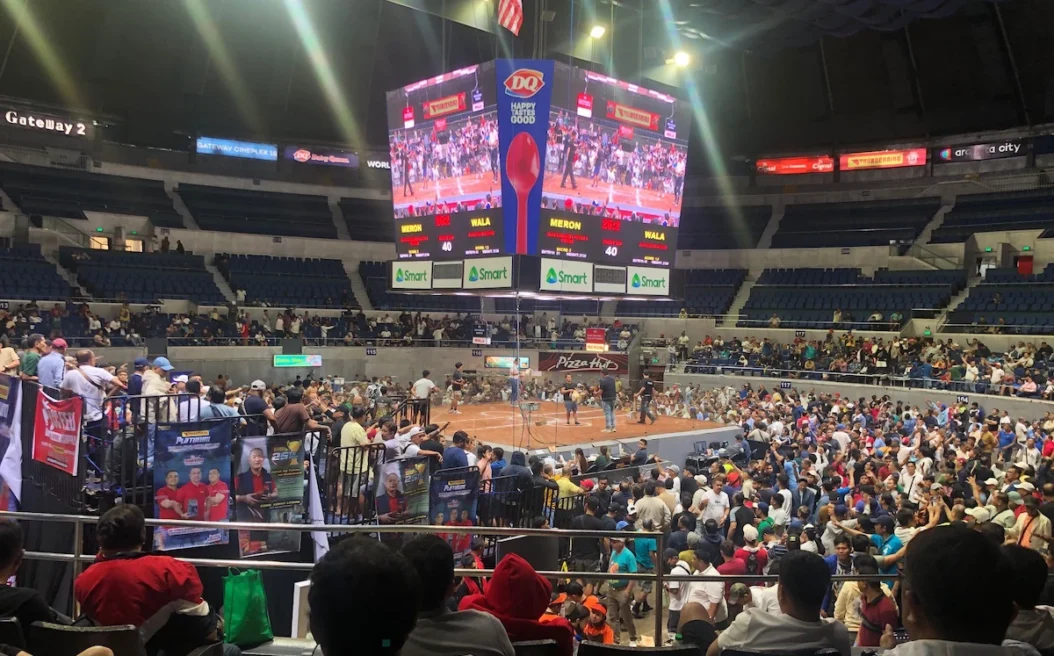
There are moments in an investigation that sear themselves into memory. For our investigators at the Center for a Humane Economy and Animal Wellness Action, that moment came inside the Smart Araneta Coliseum in Manila — surrounded by 10,000 spectators cheering as two roosters fitted with razor-sharp knives were forced to fight to the death under the glare of corporate sponsorships and a giant jumbotron.
This was the World Slasher Cup — the so-called “Olympics of cockfighting.” But what appears to be a distant spectacle in Southeast Asia is tightly tethered to the United States.
It is one of the most significant investigations ever conducted by Center for a Humane Economy and Animal Wellness Action, and today we roll out some of the information gleaned here. The key takeaway: American cockfighters, U.S.-based animal traffickers, and international airlines are fueling a sprawling, violent, multibillion-dollar gambling enterprise built on animal torture.
An American Pipeline to Animal Combat
Our investigation traces a clear trafficking route: gamefowl farms in Oklahoma, Texas, Mississippi, North Carolina, and other states; brokers from Georgia to Dallas to San Francisco who organize the shipments; and international air carriers with fight birds in the cargo hold bound for Manila.
Despite the federal prohibition in the Animal Welfare Act (7 U.S.C. § 2156) against shipping animals for fighting, traffickers employ misdirection and commit deception. Crates of fighting birds are labeled “brood fowl.” Airlines, including Korean Air, have reportedly transported these birds from the U.S. to the Philippines, even as U.S. carriers refuse to do so.
There is no legitimate commercial market for adult American roosters in Asia. These birds are exported for one reason: to slash and stab each other in pits before roaring crowds and online gamblers.
American bloodlines are prized. A trio — one rooster and two hens — can sell for as much as $5,000. Winning at the World Slasher Cup instantly multiplies the commercial value of a breeder’s birds. Orders pour in from Guam, Mexico, Puerto Rico, and the Philippines. What’s dressed up as “poultry exhibition” is nothing but an orgy of cockfighting, with billions wagered on the bloody fights.
Billions in Blood Money — and a Biosecurity Threat
There are many dynamics at work. But I want to alert you to three urgent battles:
Cockfighting in the Philippines is rooted in the nation, toxic to the participants and corrosive to that society. It is a multibillion-dollar industry supercharged by “e-sabong” — online betting platforms that allow gamblers to wager around the clock from their phones. During the COVID-19 pandemic, e-sabong generated between $3.5 and $5.3 billion annually in the Philippines alone, with the handle rising to $13 billion more recently.
The violence tied to this enterprise extends beyond the animals in the pit. In 2021, at least 34 cockfighting participants in the Philippines disappeared; their bodies were later found in Taal Lake. Where illicit gambling and trafficking flourish, corruption, money laundering, narcotics trafficking, and even murder often follow.
There is also a profound public health dimension. Dr. Jim Keen, DVM, PhD, director of veterinary science for the Center for a Humane Economy and a former USDA epidemiologist, warns that cockfighting creates a near-perfect storm for spreading H5N1 avian influenza. Birds are transported across state and international lines, crowded together, stressed, injured, and shedding respiratory secretions and blood.
Since its re-emergence in the early 2000s, H5N1 has killed more than 500 million poultry globally and infected nearly 900 people, with more than 400 deaths. Dr. Keen believes cockfighting activity in the United States has almost certainly contributed to the geographic spread of bird flu across all 50 states since 2022.
Cockfighting is more than a spectacle of cruelty; it is a superspreader of avian disease, threatening the health of commercial poultry worldwide and posing a human pandemic risk as well.
Must Shut Down the Pipeline
More lawmakers in Congress are turning their attention to the issue, and it’s time to support them.
Rep. Troy Nehls has introduced H.R. 7371, the No Flight, No Fight Act, to cut off the illegal air transport of fighting animals. It complements the bipartisan FIGHT Act (H.R. 3946, S. 1454), led in the House by Reps. Don Bacon and Andrea Salinas and in the Senate by Sens. John Kennedy and Cory Booker.
Together, these measures would:
- Prevent cartels from laundering money by gambling on dogfights or cockfights, regardless of where the fight is staged.
- Stop the smuggling of fighting roosters through the U.S. mail and commercial airlines.
- Empower law-abiding citizens to seek injunctive relief against illegal animal fighters to ease the resource burden on federal agencies.
- Allow courts to seize property used by convicted animal abusers in the commission of animal-fighting crimes.
Airlines should not serve as cargo carriers for animal fighters. Federal law already bans animal fighting in all 50 states, and bars any transports of fighting animals or implements. But in two decades since key provisions were enacted by Congress, there’s not been a single enforcement action to stop or arrest cockfighters using the USPS or airlines for movement of their contraband.
At the World Slasher Cup, American breeders sold out their birds within hours at the World Gamefowl Expo preceding the event. They routinely claim their birds are not sold for illegal purposes but rather for “agriculture” or “game bird shows.” Yet no legitimate poultry hobbyist pays thousands of dollars for birds prized for their “gameness” and “cutting ability.” The charade collapses when those same breeders appear in Manila each January to prove their birds’ prowess in the pit. We’ve got the images to prove it.
For too long, American gamefowl breeders, brokers, and airlines have been able to flout U.S. law and profit from cruelty on a global scale.
Our investigators viewed six straight days of bloodletting — more than 800 fights at the six-day spectacle. I urge you to read it and share it widely.
We have exposed the pipeline from Mid-America to Manila. Now, through a combination of more robust enforcement and fortifying of our federal laws against animal fighting, we must dismantle this illegal animal smuggling and cruelty.
Wayne Pacelle, president of the Center for a Humane Economy & Animal Wellness Action, is the author of two New York Times bestselling books, “The Bond” and “The Humane Economy.”
Dear reader: If you support substantive policy work to protect animals, please consider donating to the Center for a Humane Economy today. You can give any amount one time, or make it a monthly gift, as many of our supporters do. Thank you for helping us fight for all animals.