


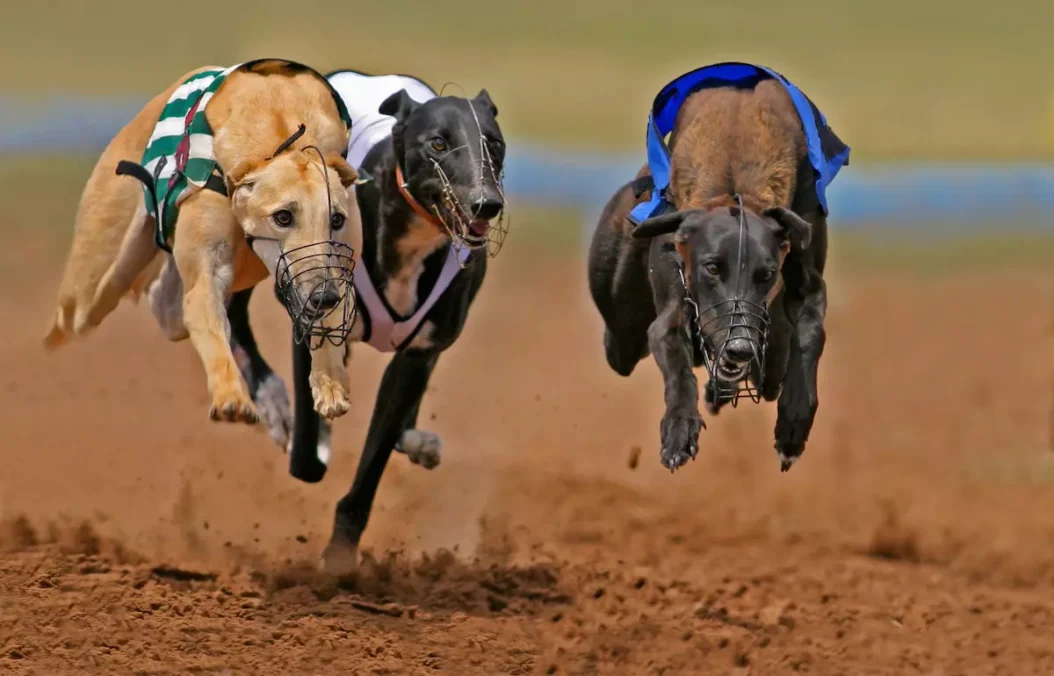
WASHINGTON, D.C. — The commercial greyhound racing industry in the United States—once a sprawling gambling enterprise with dozens of tracks across the country—has now collapsed to just two operating venues. On Thursday, the U.S. House Agriculture Committee took a major step toward closing the final chapter of that industry by adopting the Greyhound Protection Act as an amendment to the Farm, Food, and National Security Act of 2026.
The legislation would prohibit dog racing nationwide, bar U.S. gamblers from wagering on foreign greyhound races, and block the export of American dogs for racing abroad.
Once one of the nation’s largest spectator gambling sports, greyhound racing has largely disappeared from the American marketplace. A generation ago, more than 60 racetracks operated across the country. Today, racing continues at only two tracks in West Virginia, both owned by Delaware North, a New York–based gaming and hospitality company that has signaled its desire to move away from the declining business.
Greyhound racing is now illegal in 44 states, and several states have recently shut down remote wagering on dog races, including Arizona, Arkansas, Colorado, Kansas, Massachusetts, New Hampshire, and Oregon.
The Greyhound Protection Act was introduced by Rep. Salud Carbajal, D-Calif., who offered the successful amendment during the House Agriculture Committee’s debate on the Farm Bill. The legislation is co-sponsored by a bipartisan group of 28 lawmakers, including Rep. Randy Fine, R-Fla., Rep. Zach Nunn, R-Iowa, and Rep. Don Davis, D-N.C. Nunn and Davis both spoke in favor of the amendment, which passed overwhelmingly by voice vote.
“This vote reflects the reality that greyhound racing is a collapsing gambling industry that no longer has a place in the modern economy,” said Wayne Pacelle, president of Animal Wellness Action and the Center for a Humane Economy. “This is the first vote ever on the Greyhound Protection Act, and it signals that Congress is ready to finish the job and end commercial dog racing in the United States.”
The modern decline of greyhound racing accelerated dramatically after Florida voters approved a constitutional amendment in 2018 to end gambling on greyhound races. The measure passed with 69 percent of the statewide vote. At the time, Florida was the epicenter of the industry, hosting 12 of the nation’s 18 operating racetracks.
Following Florida’s action, multiple other states moved to eliminate dog racing as a form of gambling entertainment. Today, the only remaining tracks operate in West Virginia, where state law still requires greyhound racing to continue as a condition of offering other forms of casino gambling. The state also mandates annual subsidy payments of up to $22 million to owners of racing greyhounds.
Advocates say those mandates illustrate how the industry now survives largely because of regulatory structures rather than consumer demand.
“Greyhound racing once depended on a national network of tracks and betting markets,” said Carey Theil, executive director of GREY2K USA Worldwide. “That business model has collapsed. What remains is a shrinking industry sustained by mandates and subsidies rather than by the marketplace.”
Even as the industry contracts, animal welfare concerns persist. Dogs used for racing are typically confined in stacked cages for up to 23 hours a day. When released to race, they face serious risks of injury, including broken legs and backs, crushed skulls, and paralysis.
In 2024 alone, 487 greyhound injuries were reported at the final two tracks in West Virginia, including 162 dogs that suffered broken bones and 13 dogs that died.
Investigations have also documented breeders in several states killing rabbits in “live lure” training exercises used to prepare dogs for racing.
“Greyhound racing is cruel and inhumane, and it belongs in the dustbin of history,” said Christine A. Dorchak, president and general counsel of GREY2K USA Worldwide, who drafted the legislation. “In modern society, greyhounds are cherished companion animals, not gambling commodities.”
The Greyhound Protection Act has been endorsed by more than 250 organizations, including animal protection groups, local shelters, anti-gambling organizations, international NGOs, and greyhound adoption programs. In the previous Congress, a nearly identical measure attracted 80 cosponsors.
Supporters say the federal government has clear authority to address the issue because greyhounds are bred and transported across state lines for racing and because dog races are broadcast across the country for simulcast wagering.