
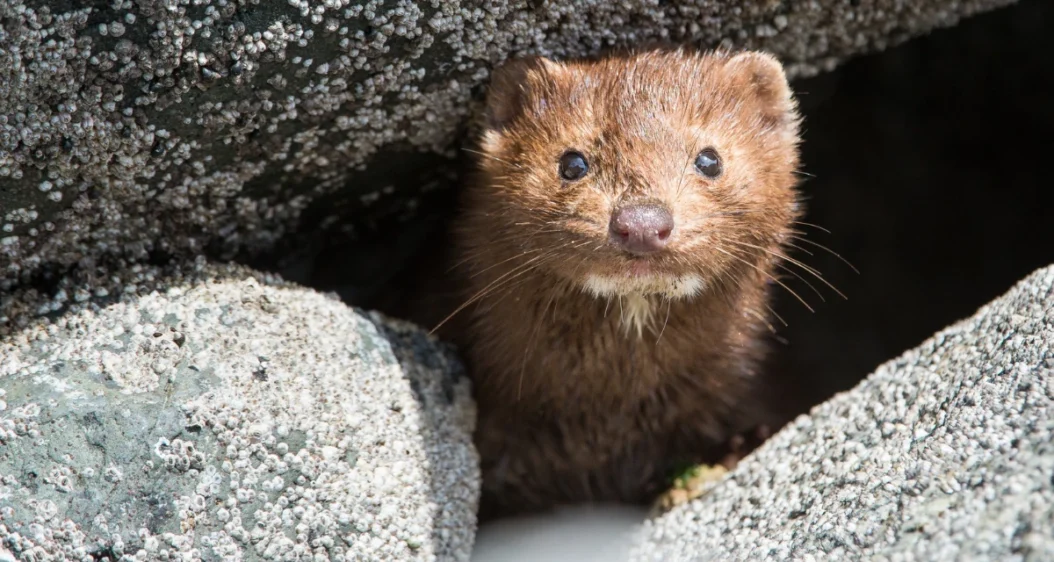
Buried in the Rotten Heart of the House Farm Bill is a Multi-Million-Dollar Subsidy to the U.S. Mink Industry
While other nations shutter mink farms because they spread cruelty and contagion, our U.S. House Agriculture Committee wants to spend your money for fur ads in China
- Wayne Pacelle and Jim Keen, DVM, PhD
It’s hard to imagine that the Farm bill could be much worse for animals and the American public.
The legislation, now starting to snake its way through Congress, is a goody bag of corporate giveaways. It does the bidding of a Chinese factory farming giant by repealing state farm animal welfare laws enacted with the votes of millions of Americans in free and fair elections. It shields a German pharmaceutical interest from liability in lawsuits about a product that allegedly caused cancer.
But one additional provision, tucked deep within the legal-speak in the 1,000-page Farm bill, would repeal a 30-year-old law that prevents your federal tax dollars from funding the marketing and promotion of the mink fur industry.
The 1996 Agriculture spending bill that President Bill Clinton signed in the fall of 1995 contained a restriction on federal tax dollars being used for “a market promotion program … that provides assistance to … the U.S. Mink Export Development Council or any mink industry trade association.”
This measure passed the House in a lopsided vote. And ultimately, it passed without any opposition in the Senate after 78 of 100 senators voted against a preliminary motion to set it aside.
If the current House Farm bill becomes law, it will repeal this law and support the luxury mink coat industry.
It’s just appalling that the House Agriculture Committee would repeal this decades-old funding restriction; only four years ago, the full House of Representatives voted to phase out domestic mink farming altogether because the mistreatment of the animals and the viral threats spawned at these factory farms are so acute.
Mink Farming as Cruel as It Comes
Minks are territorial, solitary, carnivorous animals, and when confined on factory farms, they are trapped in cages where they routinely attack and kill others of their kind.
No luxury garment is worth this kind of cruelty, especially since there is no longer any domestic market for it.
Graphic footage from an investigation in Poland by the animal welfare group Open Cages is horrifying, providing vivid evidence of aggression and cannibalism. It’s not a matter of improving animal husbandry — these wild animals simply cannot be safely and humanely group-housed in cages on any meaningful commercial scale.
The alarming video is one reason why in December 2025, Poland’s President Karol Nawrocki signed a law phasing out fur farming, making his country the 23rd of the 27 European Union member states to do so. This was a major step toward ending the mink fur trade worldwide, because Poland is currently the second largest fur-farming nation in the world, after China.
At the U.S. mink industry’s peak in 1966, when America dominated the global market, 6,000 U.S. mink farmers produced 6.2 million pelts worth about $120 million ($19.35 per pelt average) for American and foreign consumers. In inflation-adjusted dollars, a 1966 U.S. mink pelt was worth $183, and the U.S. mink industry annually generated $1.13 billion in commerce.
But this is an industry that’s been in free fall for decades. There are now just 50 or so American mink farms, producing about 700,000 pelts, generating gross farm-gate revenues of $28 million, according to the USDA. In eight of the last 10 years, mink pelt values have fallen below the break-even price for farms.
That explains why 10 to 15% of mink farms fail annually. People understand mink farming is cruel, and it’s wrong for the government to try to prop up an industry that no longer provides a product of interest to consumers.
Congress understood 30 years ago that Americans don’t want to buy mink coats. And they stopped the USDA’s handover of millions of hard-earned taxpayer dollars to bathe elite foreign consumers in mink.
With thousands of American commodities actually desired by consumers in America and across the world — whether food or fiber — can’t we find better ways to spend money, as our U.S. debt approaches $38 trillion?
It makes little sense to keep afloat a dying, subsidized industry that threatens human and wildlife health for a luxury fashion item that Americans do not want.
An Incomparably Dangerous Viral Threat to American Communities
Mink farms are near-perfect habitats for infectious agents to spawn, fester, mutate, and spread. Poor mink welfare and high zoonotic disease risk cannot be disentangled. The same intensive confinement conditions that simplify the mass rearing of mink create ideal environments for animal or human pathogens to prosper, spread, and evolve.
Of particular concern is the unique susceptibility of farmed mink to two epidemic and zoonotic viruses: SARS-CoV-2 and influenza A, the cause of most human, swine, and avian flu infections.
From 2020 to 2022, SARS-CoV-2 outbreaks occurred on at least 450 mink farms in 13 countries in Europe, Canada, and the United States. The virus infected 7 million mink and killed about 700,000 animals, including thousands of animals on at least one third of all American mink farms. Captive mink are SARS-CoV-2 “super-recipients” and “super-spreaders.”
They readily contract the virus from infected farm workers, rapidly spread it to virtually all mink on the farm (killing about 10% of exposed mink), and then (unlike any other animal) spill the virus back to people, sometimes as a dangerous mutant that may resist human vaccines and treatments. Farmed mink in Denmark, France, Latvia, Poland, and Michigan spawned dangerous SARS-CoV-2 mutants that collectively infected thousands of people and threatened to extend the lifespan of the pandemic, along with all of the consequent suffering and cost.
In October 2022, an outbreak of Highly Pathogenic Avian Influenza occurred in intensively farmed mink in northwest Spain, described in a January 2023 scientific report. Alarmingly, this H5N1 virus spread mink-to-mink, crossing the bird-mammal species barrier with ease. There were two crucial aspects of this outbreak: (1) This was the first known HPAI H5N1 outbreak with sustained mammal-to-mammal virus transmission, and (2) the mink viruses possessed an uncommon mutation (T271A) in the PB2 gene.
The point is, why would we take the risk of propping up a dying industry that poses this kind of viral menace to civilization?
It’s a luxury garment no one needs, and it jams semi-aquatic carnivores onto factory farms that could not be more ill-suited for their well-being.
Congress Has Its Priorities Upside Down on This Horrid Farm Bill
The House architects of the Farm bill want to overturn American elections and restore cage confinement of pigs by repealing California’s Prop 12 and Massachusetts’ Question 3. They want to throw a lifeline to mink-pelt producers who cannot make it on their own in the American marketplace or anywhere else in the world. They contribute no practical value to U.S. GDP, but they want to siphon off tax dollars at a time when our national debt is unimaginably large. And it’s one more pat on the back to China, where the advertising dollars will go to promote fur coats to wealthy elites.
It’s a great deal for China. They can buy mink coats and outsource the viral threats to the United States.
Wayne Pacelle is the New York Times best-selling author of the “The Bond” and “The Humane Economy.” Jim Keen, a veterinarian and epidemiologist, is a former USDA senior scientist and author of the 100-page report “Mink Farming & SARS-CoV-2” and a more compact report on the problems within the mink farming industry.
Dear reader: If you support substantive policy work to protect animals, please consider donating to the Center for a Humane Economy today. You can give any amount one time, or make it a monthly gift, as many of our supporters do. Thank you for helping us fight for all animals.