
Lead Turns Life Dead
Lead ammo by the numbers: 80,000 tons of lead ammo on 1.5 billion acres, 20 million animals killed, 60 million Americans eating lead-inflected game meat
- Wayne Pacelle
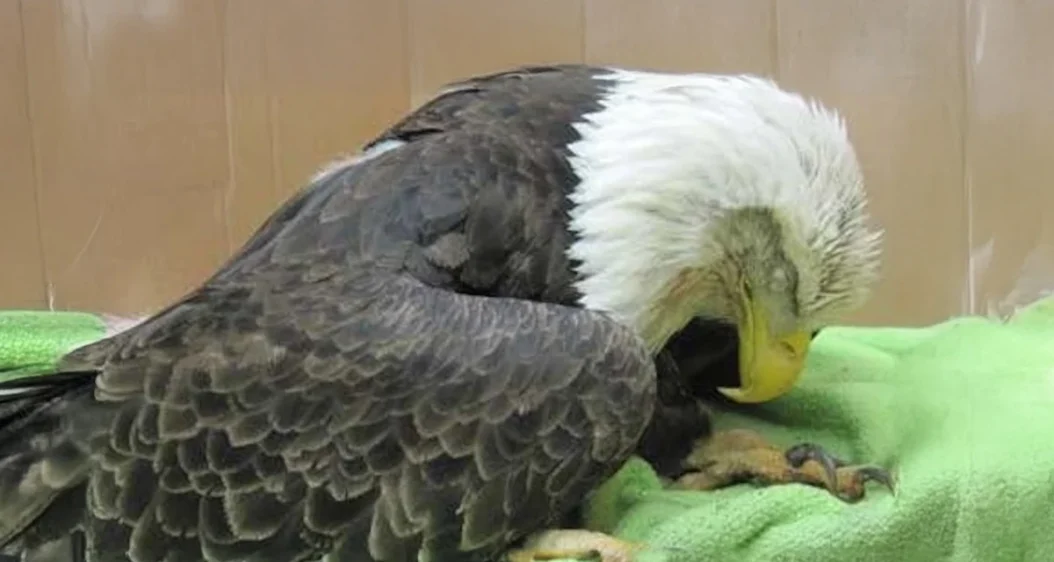
Bald eagles are dying.
It’s not DDT of yesteryear causing reproductive failure.
Eagles are perishing from plumbism, or lead poisoning. It’s happening from Alaska to Florida.
According to the Wildlife Center of Virginia, veterinarians at its hospital treated a record 76 bald eagles in 2025. Fully 70% of them tested positive for lead poisoning.
Lead rounds keep killing long after they’ve left the barrel.
When hunters shoot deer or other animals with lead ammunition, the bullets fragment into tiny shards that can scatter as far as 18 inches from the wound channel. Hunters take home the edible portion of the carcass, laced with lead and ready to be consumed by family and friends. And hunters leave toxic “gut piles” — the organs, bones, tissue, and remains of the carcass — in the forests and fields for wildlife to feast on.
In Texas, for example, hunters kill about 500,000 deer a year with lead bullets and shotgun slugs. That’s half a million gut piles that dozens of animals consume. In that state, hunters may also shoot 5 to 7 million doves, quail, pheasants, rabbits, and squirrels, and 20-40% of these animals are never recovered by hunters. The same kind of lead fragment distribution in hunter-shot game is happening in all 50 states. It’s hundreds of millions of blasts of lead bullets and slugs across the landscape.
Eagles, hawks, vultures, foxes, and other scavengers quickly descend on those remains. There’s no waste in nature. The animals pick the rotting carcass clean — lead fragments included. According to veterinarians at the Wildlife Center, a piece of lead the size of a grain of rice can fatally poison a bald eagle.
Lead poisoning causes neurological damage, tremors, respiratory distress, weakness, and starvation. Many of the birds brought to the hospital were unable to fly or even stand. Some had drooping wings. Others suffered seizures or tremors.
And it’s not just eagles. Perhaps 20 million animals a year, from 134 species of wildlife, succumb to lead poisoning.
Doing Something to Stop this Mass Poisoning
Humans have been aware of the dangers of lead for more than 2,500 years.
Yet it’s only in recent decades that lawmakers and regulators have addressed most commercial uses of lead. Lead has already been banned from gasoline, paint, toys, and many other products because of its devastating effects on the brain and nervous system.
The ammunition industry, however, still supports dispersing this poison across the natural world — fragment by fragment, carcass by carcass.
Thirty-five years ago, ammo companies fought with tooth and claw against efforts by animal advocates and conservationists to stop the poisoning of ducks and geese with lead ammunition. Then, under pressure from groups like ours, the U.S. Fish and Wildlife Service restricted the use of lead shot for waterfowl hunting nationwide. That reform did not ban possession or sale of lead ammunition, nor did it affect target shooting or use on private property. It simply required hunters pursuing ducks and geese to switch to non-toxic alternatives.
The results were dramatic: the policy is estimated to save 1.4 to 3.9 million ducks and geese every year.
Yet despite more than 600 scientific studies documenting the harms of lead exposure, progress beyond waterfowl hunting has been painfully slow.
During recent testimony before the Maryland Senate, Dr. Aisha Dickerson — a pediatrician and environmental neuroepidemiologist at the Johns Hopkins Bloomberg School of Public Health — reminded lawmakers of a simple and sobering fact: there is no safe level of lead exposure, according to the Centers for Disease Control and Prevention. (You can listen to a podcast here in which Dr. Dickerson and I discuss the impacts of lead ammo in the wild.)
Dr. Dickerson comes from a hunting family in Alabama. But she has urged her own relatives to stop using lead ammunition because of the health risks.
Lead is a well-documented neurotoxin that interferes with brain development, damages organ systems, and causes long-term cognitive harm. It accumulates in the body — in the brain, blood, and bones — and blocks calcium absorption. In children, it can impair development and reduce growth. In women, it can cause bones to become more brittle. In seniors, it can weaken bones and increase the risk of falls and serious injury.
Researchers have also documented reductions in children’s IQ scores associated with lead exposure — sometimes five to seven points or more — with consequences for learning and behavioral development that families and schools must then manage.
A recent study using advanced synchrotron X-ray imaging at the University of Chicago’s Advanced Photon Source examined venison from deer shot with traditional lead ammunition. Researchers found ultra-small lead fragments embedded in edible tissue — fragments as small as red blood cells.
“Lead dust” spreads through the animal’s circulatory system after the shot, infusing muscle and organs with microscopic contamination invisible to the human eye. Even careful trimming of the wound channel cannot remove it.
That means hunters, their families, and recipients of donated venison may be consuming lead without realizing it. More than 40 states operating venison donation programs for food banks unwittingly poison the hungry people who depend on this supplemental feeding program.
A National Campaign to Get the Lead Out
Across America, 10 to 12 million hunters annually discharge 40,000 to 80,000 tons of lead into streams, fields, and forests. This volunteer pool of hunters disperses it over a billion and a half acres — three-quarters of the land area of the United States. Hunter-discharged lead ammunition is the largest source of unregulated lead introduced into the environment.
Hunters distribute lead farther and wider than any other commercial users of lead. And because it’s done to kill animals to eat them, it’s got a more direct pathway into the human body than any other forms of lead. It’s as if people were drinking leaded gasoline or chewing on lead toys.
The remedy is plain to see. Non-toxic ammunition made from copper, steel, tungsten, and bismuth is widely available nationwide and performs as well as — or better than — traditional lead ammunition. The incremental cost difference for hunters is minimal, often amounting to just a few dollars a year and inconsequential when compared with the overall costs of hunting licenses, equipment, travel, and game processing.
Even the U.S. Army has transitioned to copper bullets for performance and environmental reasons.
And where lead ammunition has been phased out, the transition has worked smoothly.
I led a successful effort to ban the use of lead ammunition in sport hunting in California. That transition away from lead hunting ammunition was completed by 2019, working without a hitch. Seven hunting seasons have been conducted, the hunters made the switch, and the makers of guns and ammunition produced non-toxic shot and rounds to meet the market demand.
Putting a National Plan in Place to Get the Lead Out
Today, Animal Wellness Action and the Center for a Humane Economy took a major step to accelerate that transition by filing a petition in New York State calling for an end to the use of lead ammunition for hunting. We filed a similar petition in New Jersey weeks before. In February, Maryland Delegate Michele Guyton and Senator Karen Lewis Young introduced bills in Annapolis to phase out lead ammunition use over three years in that state. Other bills and petitions will follow across the nation.
In a 2024 rulemaking, the U.S. Fish and Wildlife Service wrote this about lead:
…[L]ead ammunition, including bonded lead ammunition, fragments when it hits an animal, and this distributes tiny pieces of lead within a wide radius in the soft tissues of the harvested animal… . These tiny fragments of lead are then consumed by humans eating the game meat and scavenger species eating carcasses or gut piles left behind. In this tiny, fragmented form and acted on by digestive enzymes and acids, the lead derived from ammunition can then shed particles that enter the blood stream and affect systems throughout the body, presenting both chronic and acute health risks.
Yet the agency still permits the use of lead ammunition on nearly all of the 573 National Wildlife Refuges that allow hunting. That, too, must stop.
If the guns and ammunition industry won’t protect its customers from impairment by lead in their systems, we will. If the hunting industry won’t honor at its own volition the most basic conservation and humane principles in hunting, then we will compel them to.
Habit is not a rational defense for continued conduct that poisons and kills 20 million wild animals every year. It is not a rational response to 60 million Americans put at risk of cognitive impairment and other plainly obvious health threats.
Keep lead out of circulation. Keep it below the surface of Earth, where it has been separated from living organisms for eons. When we mine it and use it in commercial products, it only spreads debilitation and death.
Wayne Pacelle, president of the Center for a Humane Economy and Animal Wellness Action, is the author of two New York Times bestselling books, “The Bond” and “The Humane Economy.”
Dear reader: If you support substantive policy work to protect animals, please consider donating to the Center for a Humane Economy today. You can give any amount one time, or make it a monthly gift, as many of our supporters do. Thank you for helping us fight for all animals.