
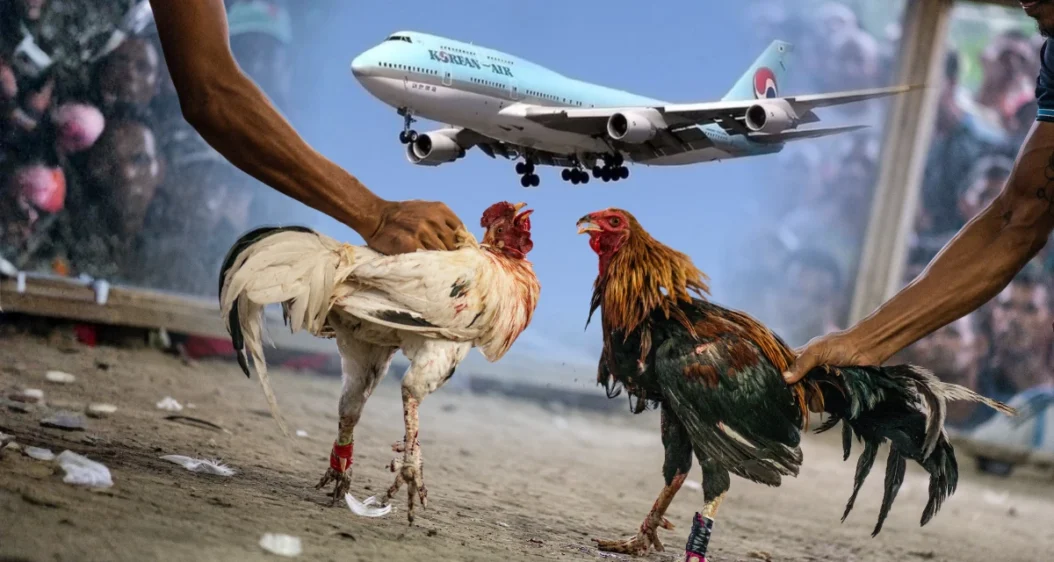
New Federal Legislation Introduced to Stop Commercial Airlines from Trafficking of Fighting Birds to 30 Nations
Our undercover investigators expose how U.S. cockfighters traffic birds overseas — fueling organized crime, violence, and a global cruelty enterprise
- Wayne Pacelle
Every day last week, one of our brave investigators sent me dispatches from Manila, where he was undercover at the World Slasher Cup — a global conclave of the world’s most inveterate cockfighters. He was there to document the presence of American participants who traveled halfway around the world with birds they illegally transported from the United States to enter them into death matches.
Our investigator determined there were 800 fights at the six-day bloodfest, with a whole cadre of Americans there to fight their birds. Referees typically didn’t stop the fights until one or both birds died, with so many of the animals succumbing to stab and puncture wounds inflicted by the long knives attached to their legs.
I cannot express enough gratitude to our investigator for taking these risks to expose this spectacle of pure violence — and the illegal smuggling of fighting birds to foreign nations.
He has described packed arenas, frenzied gambling, and handlers openly boasting about the bloodlines of their fighting birds and their prior victories at international derbies. It was a den of depravity, featuring the worst of humanity and innocent animals conscripted into death matches for bloodlust and greed.
Cockfighting and Organized Crime
It shouldn’t surprise anyone who understands the psychology of animal cruelty that there is an intertwined story of human violence and other criminality at these spectacles. In the Philippines, dozens of people have been murdered in disputes over cockfighting debts and gambling operations. It’s been headline news in the East Asian nation for the past year.
The scale of the murder and mayhem is chilling, with the bones of previously dumped bodies fished from a lake — a reminder of the contempt for life and the impunity of the power brokers in this dark world.
This is the organized crime network in the Philippines that American cockfighters are feeding. They are consorting with organized criminals when they ship birds overseas as fodder for death matches at cockfighting derbies.
And make no mistake: this represents a more extreme manifestation of the same criminal behavior that emerges when cockfighters gather in our homeland.
In its endorsement of the FIGHT Act — our priority legislation in Congress — the National Sheriffs’ Association noted that “dogfighting and cockfighting have links to crimes against people including, but not limited to, child abuse, murder, assault, theft, intimidation of neighbors and witnesses, and human trafficking.” The nation’s leading law enforcement association further states that its sheriffs’ “animal fighting investigations have uncovered intricate criminal networks and connections to organized crime, trafficking narcotics, illegal firearms, and attempted bribery of elected officials.”
These domestic crime networks that raise, train, and fight animals in America earn the most cash by trafficking them on commercial airlines to cartels and other organized criminals operating in other countries — with cockfighters on the other end buying a single fighting bird for as much as $3,000. The pipeline begins here — and the consequences ripple outward, triggering a crime wave that washes up on our shores and those of other nations throughout the world.
A Multi-Front Strategy to Dismantle a Global Criminal Enterprise
Today, as we release the first details of our international investigation, we are also announcing the introduction of new federal legislation to strengthen the law and stop Korean Air, Philippine Airlines, and other international carriers from transporting fighting animals to cockfighters or for their use in overseas fighting derbies.
For years, Animal Wellness Action and the Center for a Humane Economy have documented how American cockfighters have become the suppliers of fighting animals to more than 30 countries. U.S. law has prohibited shipping fighting birds across state or national lines since 2002, and it has been a felony offense since 2007. But in all the succeeding years, federal authorities have not brought a single criminal case against these smugglers. Airlines have continued to accept these birds as cargo, enabling traffickers to move this live contraband halfway around the globe with ease.
Late last year, our investigators uncovered an illegal smuggling ring operating out of the Dallas area, using a front company to broker shipments of fighting birds raised across the southeastern and southwestern United States and flown to the Philippines aboard commercial aircraft. Without access to commercial airlines, this trade simply could not exist at scale.
That’s why the new bipartisan No Flight, No Fight Act, H.R. 7371, is so critical. The bill, led by Rep. Troy Nehls, R-Texas, restricts the transport of adult roosters on commercial airlines and provides plain-language standards that make clear to carriers that they must not accept these animals as cargo. It strengthens enforcement on the front end — stopping the crime before birds ever take flight.
Airlines should not be serving as cargo carriers for cartels and other illegal operators.
Importantly, the No Flight, No Fight Act is a direct complement to the FIGHT Act — comprehensive legislation we have championed for years, which now has the backing of more than 1,050 endorsing organizations nationwide.
We are pressing Congress to act on both bills simultaneously, even as we continue our work in the field to ensure existing state and federal laws are enforced right now, not someday.
And we are going further still. We are advancing the Animal Cruelty Enforcement Act and the FBI Animal Cruelty Taskforce Act to build real policing and prosecutorial capacity across the country.
County sheriffs have warned that without dedicated federal resources, animal fighting cases are too often ignored, even though investigations routinely uncover drugs, weapons, money laundering, and violence against people. The ACE Act and the FBI Animal Cruelty Taskforce Act are designed to build federal law enforcement capacity to make arrests and lawyers to prosecute animal cruelty perpetrators. Only with more personnel investigating these crimes and making arrests can these cockfighting and dogfighting rings be dismantled.
This is what a serious multi-pronged campaign against animal fighting looks like: legislation, investigations, enforcement, and capacity-building. It is the only way to confront an underground enterprise of vast scale, involving an estimated 20 million fighting birds in the United States and thousands of dogfighting operations operating in parallel criminal networks.
As the chief information officer of Rose Acre Farms, one of the nation’s largest egg producers, has warned, “The illegal movement of birds outside regulated agricultural channels poses a real threat to animal health and to the stability of the U.S. food system. We’ve already seen how avian influenza can devastate farms and drive up food prices. Allowing fighting birds to be shipped internationally through commercial airlines is an unnecessary and dangerous risk.”
There’s so much at stake — the well-being of the animals conscripted into fighting, the spread of disease and death to millions of other birds, a crime wave in our communities and across the world. You enable us to confront these horrors with purpose and thoroughness. In the weeks ahead, we will release more findings, press airlines to shut down this trade immediately, and demand congressional action on all four bills that together form the backbone of our strategy.
We are committed to dismantling the most deeply entrenched, clandestine forms of cruelty in our world, and that starts with our efforts to eradicate the scourges of dogfighting and cockfighting.
Wayne Pacelle, president of Animal Wellness Action and the Center for a Humane Economy, is the author of two New York Times bestselling books, “The Bond” and “The Humane Economy.”
Dear reader: If you support substantive policy work to protect animals, please consider donating to the Center for a Humane Economy today. You can give any amount one time, or make it a monthly gift, as many of our supporters do. Thank you for helping us fight for all animals.