
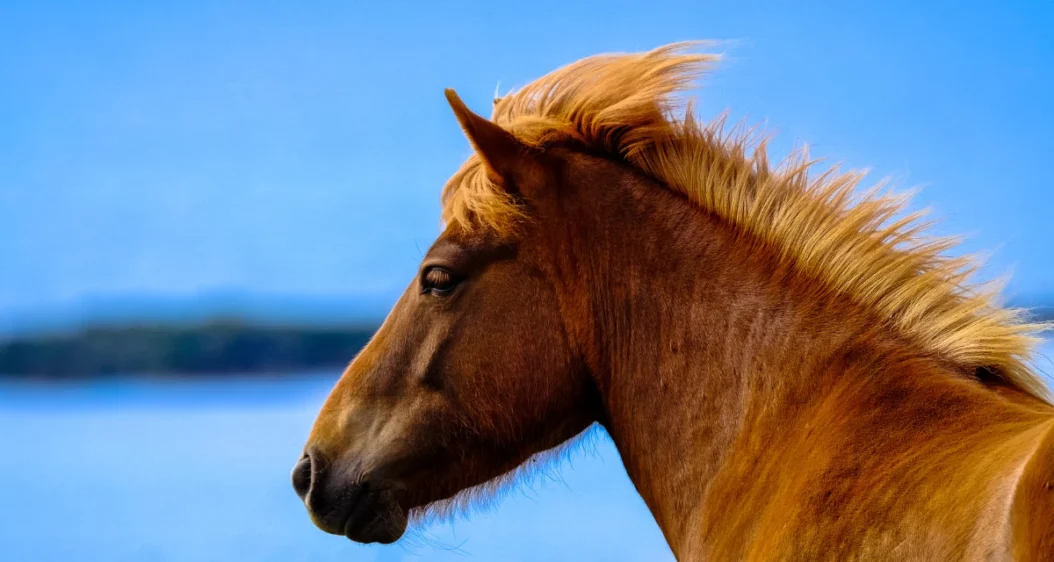
Congress Must Halt Live Exports of Equines to Mexico and Canada
Congress banned domestic horse slaughter years ago, yet thousands of American horses are still shipped overseas to be killed.
- Wayne Pacelle
Twenty years ago, in testimony delivered to the members of the U.S. House Energy and Commerce Committee, the late wildcatter and billionaire businessman T. Boone Pickens rightly labeled horse slaughter “America’s dirty little secret.”
Most lawmakers concurred. But in the intervening years, the National Cattlemen’s Beef Association and a few other livestock interests influenced some key legislators to obstruct that comprehensive anti-slaughter legislation.
Sure, every year for the past two decades, federal lawmakers have included language in annual spending bills to forbid the domestic slaughter of American horses. That’s been a very good thing. Since 2007, there’s not been a single horse walked into an American slaughter plant.
But there’s been legislative stasis on the other key legislative provision:forbidding live exports of horses for slaughter.
As a consequence, there were more than 26,000 American equines exported to Mexico and Canada in 2025. There, men stab horses with eyes as wide as saucers, or they slit their throats, or shoot them in the head. They then take to the task of butchering them for reexport, mainly to a handful of consumers in a handful of Asian nations.
The U.S. House Committee on Agriculture may later this month take up a Farm bill, and historically, that bill has been a legislative vehicle for some animal welfare legislation. It’s time for that committee — and the entirety of Congress — to take up and pass an amendment to prevent U.S. horses from being slaughtered for human consumption, including by limiting the export of live horses for that purpose.
The House anti-slaughter bill, H.R. 1661, has 225 cosponsors — more than half the total number of U.S. House members. Likely, another 100 or even 150 lawmakers would vote with that group, were an amendment to come to the floor.
Let the full House vote on the issue. The dissenters will be lonely voices, drowned out by the values of their colleagues who are actively representing the 90% of Americans who want horse slaughter to end.
Enough of the delays. The obstructionism. The excuse-making. We all know better. Butchery is no way to treat a horse guilty of no offense.
Vote up or down on the question.
And the truth is, why would lawmakers even care about keeping horse meat on the menu at no-name restaurants 6,000 miles away from Washington, D.C.?
Not a Good Reason in the World to Slaughter Horses for the Plate
Eating horses was something reserved for desperate settlers in 19th-century America — like the famed Donner Party members who faced starvation after being trapped in ice and snow in the High Sierras. But absent this sort of lifeboat context, raising a fork dripping with the juices of horse sirloin might trigger the same gag reflex as putting dog ribs or cat brisket on your plate.
The personal affections and practical values of horses have long outweighed even the blinding impulses of appetite. Add in their cultural significance as partners in travel and commerce, marvels of sport and endurance, four-footed fellow soldiers in battle — from U.S. Grant’s Cincinnati to Roy Rogers’ “Trigger” to Seabiscuit and Secretariat to the fictional “Mr. Ed” — and the very idea of horse slaughter seems traitorous.
Countless people have lived the American experience from the high perch of the saddle. Horses helped us stretch the boundary lines of the United States, enabled us to find gold and other riches, and served us in all of America’s great conflicts on American soil. Battered troops knew that help was on the way when the cry was heard that “the cavalry was coming.”
That’s why it was always a contradiction to learn of dozens of horse slaughter plants operating in our nation over decades, quietly gathering up animals never raised for food yet butchering them for diners in foreign markets (and, for a time, for domestic consumption by our pets and zoo animals).
Decades ago, there were more than two dozen U.S. horse slaughter plants, perhaps chewing up more than a million equines a year. Today, it’s just a fraction of that number.
As the world population has swelled to 8 billion, the demand for horses worldwide has continued to slide. While butchering 26,000 horses does cause plenty of suffering, it’s a giant nothing-burger when it comes to global meat consumption. It doesn’t measure one-thousandth of 1% of total global meat consumption.
If it all went away tomorrow, the shoulder shrugs would be sparse. And the foreign gourmands would no more get in a twist than if the restaurant had sold out of corn on the cob or chocolate cake.
Really, who would care a wit?
Time to Put Horse Meat on the Congressional Agenda
The Save Our Forgotten Equines (SAFE) Act, led by Sens. Lindsey Graham, R-S.C., and Ben Ray Lujan, D-N.M., and Reps. Vern Buchanan, R-Fla., and Jan Schakowsky, D-Ill., seeks to close out the ignoble practice of exporting live horses for slaughter. It would do so by revising the 2018 Dog and Cat Meat Trade Prohibition Act, passed as an amendment to the 2018 Farm bill, and add “equines” to the prohibition against companion animal slaughter.
The Gross Domestic Product (GDP) of the United States — which measures the total value of all goods and services produced in a year — is about $30 trillion. Are we really so desperate for commerce that we must abet the trafficking of 26,000 horses to provide loose change for a ragtag group of kill buyers, kill pen operators, and kill transporters?
You won’t find the sight or scent of horse meat on the menus of any rib joint or steakhouse in America. Horses have always been more than mere table fare in the long-running story of the United States.
If it’s wrong to slaughter American horses for human consumption in the United States, it’s wrong to slaughter American horses in Canada or Mexico.
And no one disputes that there are some homeless horses, just as there are homeless dogs and cats. The horse slaughter crowd, let it be said, though, treats homelessness as an economic opportunity rather than a moral responsibility.
There’s nothing redeeming about the kill buyers’ ruthlessness and predatory behaviors. Nor is there anything redeeming about their disdain for the role of the horse in the American story, or their present failure to appreciate the manes and mystique of these glorious creatures.
Wayne Pacelle, president of Animal Wellness Action and the Center for a Humane Economy, is the author of two New York Times bestselling books, “The Bond” and “The Humane Economy.”
Dear reader: If you support substantive policy work to protect animals, please consider donating to the Center for a Humane Economy today. You can give any amount one time, or make it a monthly gift, as many of our supporters do. Thank you for helping us fight for all animals.