
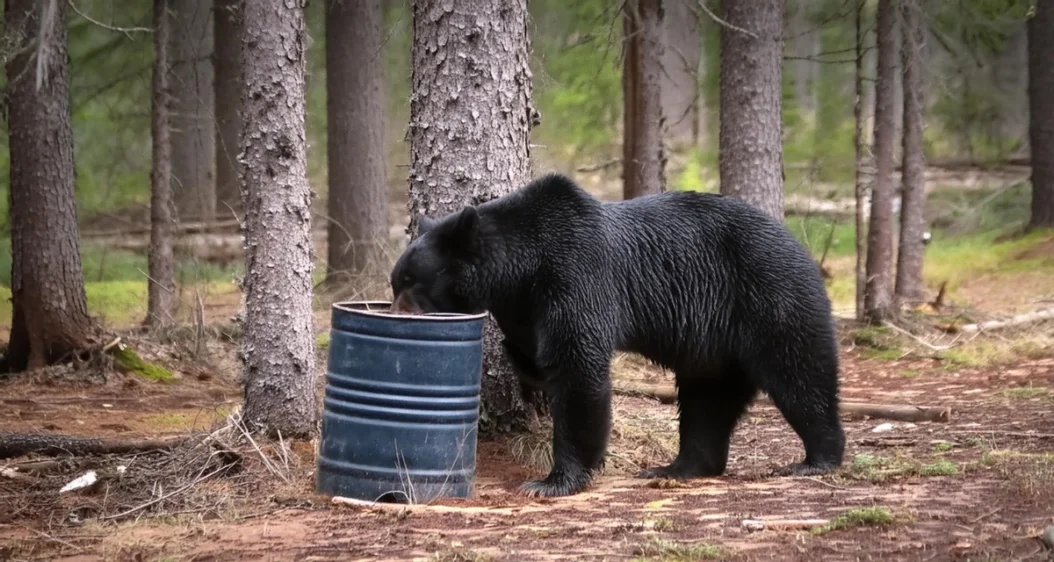
National Park Service Units Must Be Off Limits to Bear Baiting
Political leaders at the Interior Department making one more run to allow garbaging for grizzly bears and black bears on lands in Alaska never meant for such reckless, unfair conduct
- Wayne Pacelle
Where bears are found across America’s public lands — whether managed by the National Park Service, the U.S. Forest Service, the U.S. Fish and Wildlife Service, or the Bureau of Land Management — visitors see the same warning posted at trailheads and campgrounds: “Never feed bears.”
Bears accustomed to human food lose their wariness of people and sniff out campsites, cabins, and vehicles for a quick caloric hit. Sure as shooting, bears are then labeled a “nuisance” and killed. It’s the people feeding bears who were the nuisance. And they might as well have pulled the trigger on the bear.
This is Wildlife Biology 101. And that’s why it’s distressing to see political leaders at the Department of the Interior again break from the norms of wildlife management, commonsense conservation, and public safety in an effort to restore the baiting of grizzly bears and black bears on 20 million acres of National Park Service lands across Alaska.
Yet this week, they proposed a rulemaking to let trophy hunters haul garbage onto national preserves and hide nearby to shoot bears at point-blank range when the bears have their heads in barrels or bags of that garbage.
Seen in its broadest light, the current political leaders at Interior want to dumb down protections for wildlife on National Park Service units and default to state management. This wouldn’t be the first time that state lawmakers or political appointees at state and federal wildlife agencies catered to the whims of the Safari Club and the NRA by allowing unconscionable wildlife-taking practices.
The National Park Service has a stricter, more conservation-minded mission than other federal land management agencies. Its Organic Act requires the agency to “conserve the scenery and the natural and historic objects and wildlife” of all units, “leave[ing] them unimpaired.”
A camper in Yellowstone can face a $5,000 fine and six months in jail for leaving food unsecured, while in some national forests abutting that national park, hunters can legally dump hundreds of pounds of human food for weeks — so long as the goal is to shoot the bear.
That’s why the Interior Department’s attempt to degrade National Park Service standards by allowing baiting is such an overreach and such an unconscionable idea.
Baiting Predators Creates Real Danger
In its 2024 rulemaking to maintain the prohibition on bear baiting on Alaska’s national preserves, the National Park Service highlighted acute risks from allowing trophy hunting to drag mounds of food onto these lands to lure bears into shooting range.
In adopting the anti-baiting rule, the NPS noted that it intended to “lower the probability of visitors encountering a bait station where bears may attack to defend a food source” because “bears may defend a bait station similar to how they would defend a carcass … ” The NPS emphasized that feeding bears with human food waste “encourages bears to become conditioned to human-provided food, increasing the likelihood of negative human–bear interactions” because the artificial foods used in bait piles “are not a natural component of animal diets” and “do not degrade quickly … resulting in a continued public safety risk of bears defending a food source.”
The NPS sought extensive input from experts across the continent before issuing the rule. “In the winter of 2022-2023, the NPS queried 28 North American bear management and research biologists from state and provincial agencies, universities, and non-NPS Federal agencies,” noted the NPS in announcing the rulemaking in 2024. “All 28 [biologists] agreed that baiting bears as allowed under State law was functionally equivalent to feeding bears.” These top North American bear biologists “considered the overall risk of bear baiting to the visiting public to be moderate to high.”
That is exactly the kind of precaution one would expect from an agency charged with managing lands and wildlife that attract people who hike, fish, camp, and hunt. Allowing an unsporting, dangerous practice like bear baiting puts visitors at risk. And since most states with bears ban baiting, we know it’s hardly essential for the hunt.
A Reversal of the 2024 Safeguards
The bear baiting proposal by the political appointees at the Department of the Interior is the latest turn in a long-running struggle over predator-killing practices on Alaska’s national preserves.
In September 2022, U.S. District Judge Sharon Gleason ruled that the 2020 rule that sought to restore bear baiting violated the Administrative Procedure Act in several respects. The court found the rule “arbitrary and capricious” because the agency ignored its earlier finding that state regulations did not adequately address public safety concerns tied to bear baiting.
However, the judge did not immediately invalidate the rule. Instead, she tossed it back to the National Park Service for reconsideration, meaning it remained technically in place while the agency rewrote the regulations. Following the court decision, the National Park Service reexamined the rule and watered it down. But it did resolve that bear baiting would continue to be outlawed on national preserves.
Animal Wellness Action and the Center for a Humane Economy welcomed that decision. Frankly, though, it didn’t go far enough. The agency did not move forward with provisions that would have limited other aggressive assaults on wolves and bears pushed by the Alaska Board of Game to boost moose and caribou numbers — even though the Park Service’s own management policies forbid actions that disrupt the workings of ecological systems. But the agency in 2024 sought to take the least controversial action — to stop baiting — while it threw a bone to some of the most hardcore hunting groups that always seem hungry for killing opportunities of every type.
No Sensible Agency or Person Supports Bear Baiting
In the 1990s, I led winning ballot measures in Colorado, Oregon, and Washington to ban bear baiting. And I learned that the effect of bear baiting bans was to give a lift to hunting. In the wake of voters passing bans on bear baiting and hounding, more hunters chose to participate in bear hunting because they didn’t have to compete against hunters cheating and skirting the rules of “fair chase.”
These states experienced a windfall of additional hunting license revenue. In states where the hunt is stacked with bait or dogs, bear hunting licenses are far fewer, and commercial hunting guides dominate the action, catering to out-of-state hunters who may pay $10,000 or more to shoot a trophy bear in a guaranteed kill.
The principle is simple: Our public lands should not be dumping grounds for garbage piles designed to lure wildlife into easy kills. In Congress, we’ll press the broader case for sane, consistent policies among all federal land managers, while in the federal courts, we’ll fight to keep baiting out of units of the National Park Service.
National preserves in Alaska were not created primarily as private hunting grounds. They are public landscapes where Americans come to experience wild ecosystems where wild animals live and behave in natural ways and rely on natural food sources.
It’s time for Interior Department leaders to read and heed the warning signs on all public lands. Don’t feed bears.
Wayne Pacelle, president of the Center for a Humane Economy and Animal Wellness Action, is the author of two New York Times bestselling books, “The Bond” and “The Humane Economy.”
Dear reader: If you support substantive policy work to protect animals, please consider donating to the Center for a Humane Economy today. You can give any amount one time, or make it a monthly gift, as many of our supporters do. Thank you for helping us fight for all animals.