
Factory Farm Bill Aims to Set Back the Animal Protection Movement
U.S. House debate on the bill, replete with provisions to benefit foreign companies and a relative handful of foreign consumers, is here
- Wayne Pacelle
The American public cares deeply about animal well-being. You wouldn’t know it, though, if you dig into the legislative details of the Farm Bill – better defined as the “Factory Farm Bill” – hurtling towards the floor of the U.S. House of Representatives for consideration this week.
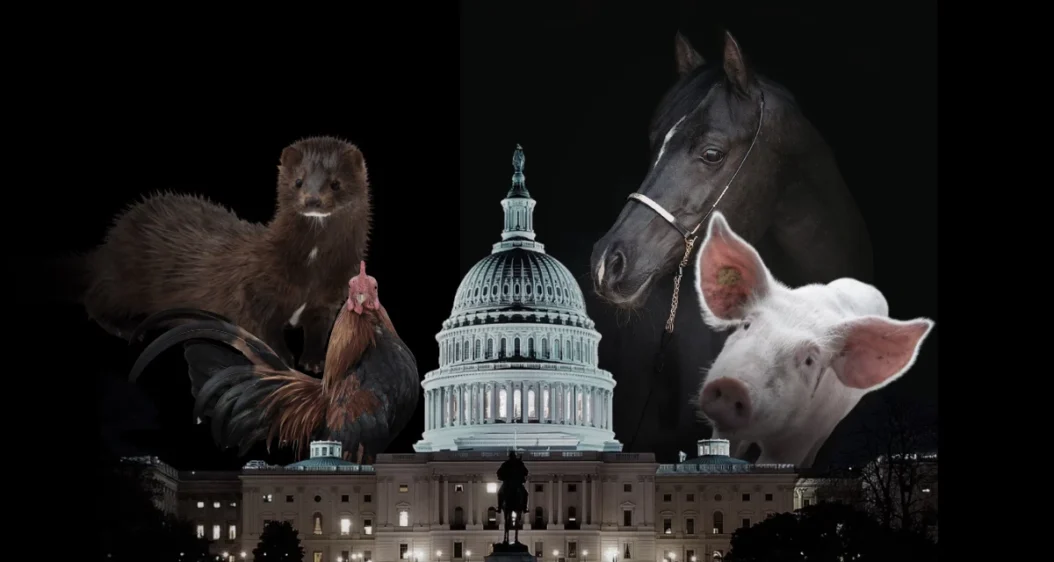
This Factory Farm Bill does nothing to help animals, omitting humane, bipartisan proposals circulating in Congress to stop horse slaughter and to crack down on dogfighting and cockfighting. Instead of doing some good for animals, the Factory Farm Bill puts a bullseye on two vital animal protection campaigns in the United States: 1) Cage-Free Future, combating extreme confinement of breeding sows crammed into gestation crates, and 2) ReThink Mink, halting abuses of wild mink jammed into cages and killed for their pelts for a relative handful of foreign consumers.
With your help, we can strip the Factory Farm Bill of its extreme anti-animal provisions and add in provisions that reflect Americans’ rightful contempt for the abuse of horses and the scourge of staged animal fighting.
We need your help to pass the following four amendments to the Farm Bill on the House floor.
Confinement of Sows in Immobilizing Gestation Crates
Amendment #28, by Reps. Anna Paulina Luna, R-Fla., James Costa, D-Calif., and Andrew Garbarino, R-N.Y., would strike the Save Our Bacon (SOB) Act, inserted into the Factory Farm Bill, that seeks to overturn two statewide ballot measures–Prop 12 and Question 3–that stop the use of two-foot-by-seven-foot gestation crates that immobilize the animals for the duration of their lives.
The SOB Act seeks to overturn American elections – specifically the votes of more than 10 million Americans who voted to stop in-state confinement of sows and the in-state sale of meat from those factory farms. Should the SOB Act be enacted, it will jeopardize markets for thousands of American pig farmers who invested in more humane housing and accelerate foreign control of American pig production.
China’s Smithfield Foods already controls a quarter of U.S. pig production, and if the SOB Act passes, we’ll see more American farms gobbled and farmers driven out of business. China’s favored housing system for pigs is the towering 25-story factory farm where the animals live high on the hog floors and never feel a ray of sunlight or feel a blade of grass. It’s a dystopian vision of agriculture, and there will be little we can do to stop Smithfield Foods – China’s proxy company with an already massive footprint in the United States – from starting construction in our homeland if our most important state farm animal welfare laws are gutted.
Halting the Slaughter of American Equines for Human Consumption
Amendment #24, by Reps. Vern Buchanan, R-Fla., and Jan Schakowsky, D-Ill., ends the trade in exporting American horses for slaughter in Canada and Mexico and codifies the domestic ban on horse slaughter. “Kill buyers” gather up 25,000 healthy American horses a year and ship them to Mexico and Canada to be butchered, so that their meat can be re-exported to Japan for a relative handful of consumers. Horses have served Americans faithfully for more than two centuries, and it is a betrayal of our bond to hack them up for a specialty meat product.
Ending Lucrative, Illicit Commerce in Fighting Animals
Amendment #22, by Reps. Troy Nehls, R-Texas, and Troy Carter, D-La., strengthens enforcement against dogfighting and cockfighting by enabling law enforcement to seize fighting equipment and fighting pits after a criminal conviction, and also puts a hard stop to illegal trafficking of fighting roosters by the U.S. Postal Service and some major international air carriers, such as Korean Air and Philippine Airlines. Our investigations have documented tens of thousands of fighting animals shipped in the mail by cockfighters and transported in comparable numbers on major international airlines from the United States to Mexico, the Philippines, and 25 other nations. Dogfighting and cockfighting are forms of organized crime, and that is why we are glad to be joined by the National Sheriffs’ Association and nearly every other major law enforcement agency in America in promoting the policies built into Amendment #22.
Preventing the Revival of Multi-Million Dollar Subsidies to the Mink Industry
Amendment #39, by Reps. Brian Fitzpatrick, R-Pa., and Rosa DeLauro, D-Conn., keeps in place a 30-year-old federal law that forbids spending millions of dollars on foreign fashion shows in China and South Korea to promote U.S.-produced mink pelts. Mink farms jam solitary, territorial carnivores into small cages, where the semi-aquatic animals face unending deprivation and acts of aggression from their cage mates. Mink factory farms are also well-known superspreaders of dangerous viruses that can spill over and threaten public health.
On the House floor in 1995, when Congress put a stop to mink subsidies, former Congressman Chris Shays, R-Conn., succinctly explained his vote to end the mink subsidy by saying, “I have a hard time recognizing we have annual deficits at over $200 billion a year, our national debt is close to $4.8 trillion… but we are going to subsidize . . . mink export?”
Those points are more valid now than ever before. Our national debt and annual deficits are both nearly nine times larger than what they were in 1995. At a time when every American taxpayer’s share of the national debt is over $350,000 and climbing, Congress should not be spending money it does not have to prop up a dying industry that serves wealthy elites in China.
A Factory Farm Bill for Foreign Corporations and Consumers
The Factory Farm Bill is corrupt at its core, allowing foreign interests to exert an extraordinary influence on American policy and subverting American values and businesses.
It does not have to be this way, though. By passing amendments #22, #24, #28, and #39, your federal lawmakers can denude the bill of its most destructive features and add in provisions that do some good for animals and honor the sensibilities of the American people.
But now is the moment we need your engagement. Demand that your lawmakers fight for these amendments. Don’t waste a moment. The battle is upon us.
During normal business hours, please call your U.S. Representatives at 202-225-3121 and urge them to support animal welfare and back Amendments #s 22, 24, 28, and 39.
Dear reader: If you support substantive policy work to protect animals, please consider donating to the Center for a Humane Economy today. You can give any amount one time, or make it a monthly gift, as many of our supporters do. Thank you for helping us fight for all animals.