
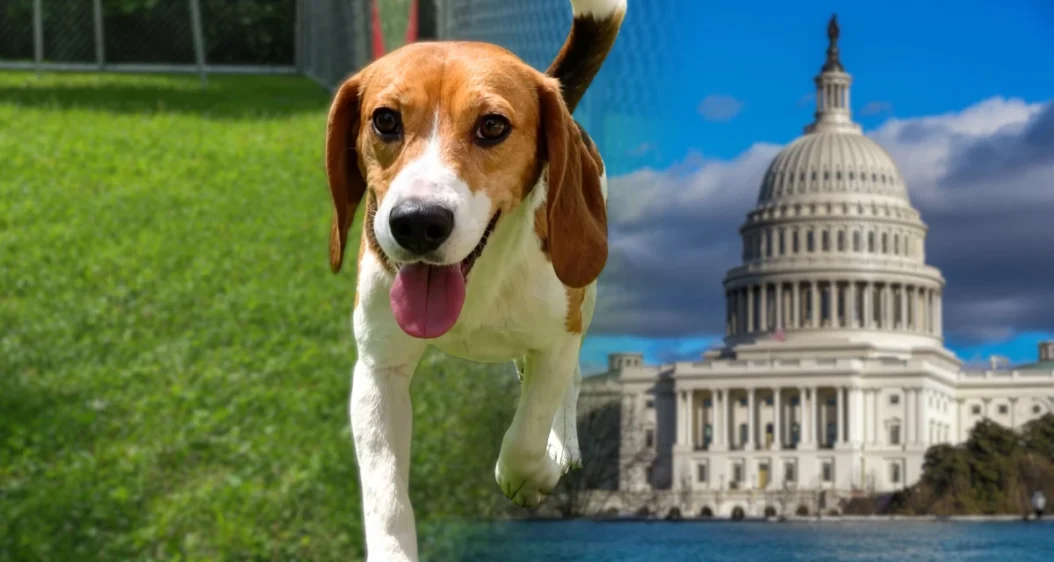
Are We on the Cusp of a New Era of Cruelty-Free Medicines?
The rescue of 1,500 beagles from Ridglan Farms and congressional action on the FDA Modernization Act 3.0 are encouraging signs
- Wayne Pacelle
This week, we are completing the happy task of moving the last of the 1,500 beagles we obtained from Ridglan Farms to rescue and shelter groups, in accordance with our agreement with the Wisconsin-based lab-animal supply company.
Also this week, a key U.S. House subcommittee passed the FDA Modernization Act 3.0 by acclamation — approving the measure we formulated more than three years ago to ensure that outdated agency regulations no longer call for animal testing when the law doesn’t require it.
There is some part coincidence in these two events and some part correlation at work.
Companies selling dogs to research institutions for painful and invasive experiments are facing a new, immense threat to their decades-old business model. When we passed the FDA Modernization Act 2.0 in 2022 — eliminating an 84-year-old animal testing mandate — it upended the security of animal suppliers and put them on notice that they’d finally see competition from animal-free testing models, such as organs-on-chips, AI, and other 21st-century methods.
Ridglan Farms also struggled with compliance on animal care, and when a special prosecutor extracted an agreement from the company to stop selling beagles to research institutions starting July 1, it created an opening for our entreaties to the company. I didn’t want to see a fire sale of the dogs in their possession; I wanted to get them into safe hands.
While the release of the beagles to the Center for a Humane Economy and Big Dog Ranch Rescue was an enormous marker of progress, it’s also been plain to me since 2022 that the shift away from animal testing is unfolding too slowly.
That’s precisely why Animal Wellness Action and the Center for a Humane Economy worked with allies in Congress to tee up the FDA Modernization Act 3.0 — to push Congress to signal to the FDA and other agencies within the Department of Health and Human Services that they must begin the transition away from animal testing to a new era of human-based, animal-free screening for drugs and other medical treatments. Many thanks to Reps. Buddy Carter, R-Ga., Nanette Barragán, D-Calif., Diana Harshbarger, R-Tenn., and Rosa DeLauro, D-Conn., for leading the way on that legislation in the House.
When Will the Era of Cruelty-Free Medicines Arrive?
We are winding down the era of animal testing in cosmetics. But we are still in the early stages of the movement to reduce the use of animals in testing for new drugs — which is, by a long shot, the largest driver of the use of animals in testing.
Cruelty-free cosmetics has long been part of the lexicon of social reform and beauty aids. But far fewer people are familiar with our campaign to modernize drug testing and create cruelty-free medicines.
Indeed, if you took any kind of medicine — a drug to relieve pain, or to fight cancer, or to slow Alzheimer’s, or to shed pounds — you were taking a drug that had been tested on animals. Beagles, primates, rabbits, rats, mice, and others.
The pharmaceutical sector has annual gross revenues of $1.35 trillion. Its use of animals dwarfs the use of animals in any other sector.
The transition away from the use of animals is neither inevitable nor simple. It will require more human innovation, more legislative reform, and more regulatory pressure. It will also require sustained public engagement and protest to put a stop to the conscription of animals in an archaic system of drug development.
That’s why the rescue of the Ridglan beagles and the advancement of FDA Modernization Act 3.0 are so tightly linked. One reflects the growing instability of the animal testing supply chain. The other accelerates the transition to a more modern and more humane system of science. Congressman Nick Langworthy, R-N.Y., captured these sentiments beautifully in his speech at our press conference this week in Madison, Wisconsin. You can view his remarks here.
Accelerating Change to Animal-Free Testing
The uncontested House Health Subcommittee passage of the FDA Modernization Act 3.0, following unanimous passage of the same policy in the Senate five months ago, marks one more important step in our long-running campaign to modernize drug development and reduce animal suffering.
The key pivot point in the larger process was our work to secure enactment of the FDA Modernization Act 2.0 in 2022, led by Rand Paul, R-Ky. and Cory Booker, D.N.J. in the U.S. Senate. That landmark law eliminated an 84-year-old federal mandate requiring animal testing for experimental drugs before human trials. It was one of the most consequential animal testing reforms solely because it opened up competition in drug screening.
And the truth is, the long-standing model of drug development cannot withstand competition. The drug development system is broken. Pharmaceutical companies and biotech firms routinely defaulted to animal tests because federal law required it. The statute boxed innovators into outdated protocols that often produced unreliable data and delayed the development of treatments for patients who didn’t have time to wait.
Animal tests, in large part, are not predictive of the human response to drugs, with 90-95% of drugs and vaccines found safe in animal tests failing during human clinical trials. The cost for developing a single new drug may exceed $2 billion, while the average timeline of development of a potential drug or vaccine from the lab to market is 10 to 15 years.
Learn more about the Ridglan Rescue and how to help during our special live webinar, Tuesday, May 19, at 8 p.m. ET.
The people profiting from selling and using animals in drug development say that the alternative methods still need more work. But what do they say of the abysmal failure of animal tests? In what sector of automobile manufacturing, telecommunications, sports, or education would we accept failure rates above 90%?
Our Modernize Testing campaign has never relied just on moral concerns about animals. Drug development with animals at the center of the R&D process is a public health issue, a scientific modernization issue, and an economic competitiveness issue.
To put a sharper point on it, it’s a life-and-death issue for millions of Americans battling disease. Our drug development system inevitably produced a few good outcomes along the way — and it would be impossible for it not to do so with tens of trillions spent on the process.
But we should expect much more than immensely costly drugs, a dizzying array of side effects from drugs that get to market, and a failure to find cures for so many diseases and ailments that degrade and shorten the quality of life for millions of people.
From Envigo to Ridglan to Marshall BioResources
The Ridglan Farms story comes just a little more than three years after the collapse of Envigo in Cumberland, Virginia. At Envigo, federal authorities documented unlivable conditions for roughly 4,000 beagles. The federal government’s closure of Envigo reverberated through the research animal supply chain. The American public didn’t like what it saw when the curtain was pulled back.
Now we are seeing events play out at Ridglan, and people don’t like that either. And looming is Marshall BioResources, the largest remaining beagle breeder for research in the United States, with more than 20,000 dogs in its pipeline. The American public won’t like a scaled up version of Envigo or Ridglan Farms.
What we have achieved so far — from the closure of Envigo, to the release of the Ridglan beagles, to passage of FDA Modernization Act 2.0 and now advancement of FDA Modernization Act 3.0 — represents some of the initial volleys in a much larger campaign to replace outdated animal testing with superior human-relevant science.
We are seeing fissures in the foundations of an animal-testing model developed and institutionalized in the Depression era. But it’s way too early to write the obituary of the animal research industrial complex, with all the power and money built into that system.
Passage of the FDA Modernization Act 3.0 by acclamation in the House subcommittee is an encouraging sign that lawmakers in both parties understand the trajectory of the issue. But it’s up to all of us not to relent in our quest to usher in a model of disease treatment and cures — one that doesn’t leave a trail of tormented beagles, primates, and other animals in its wake, harmed for no good reason at all.
Wayne Pacelle, president of the Center for a Humane Economy & Animal Wellness Action, is the author of two New York Times bestselling books, “The Bond” and “The Humane Economy.”
Dear reader: If you support substantive policy work to protect animals, please consider donating to the Center for a Humane Economy today. You can give any amount one time, or make it a monthly gift, as many of our supporters do. Thank you for helping us fight for all animals.