
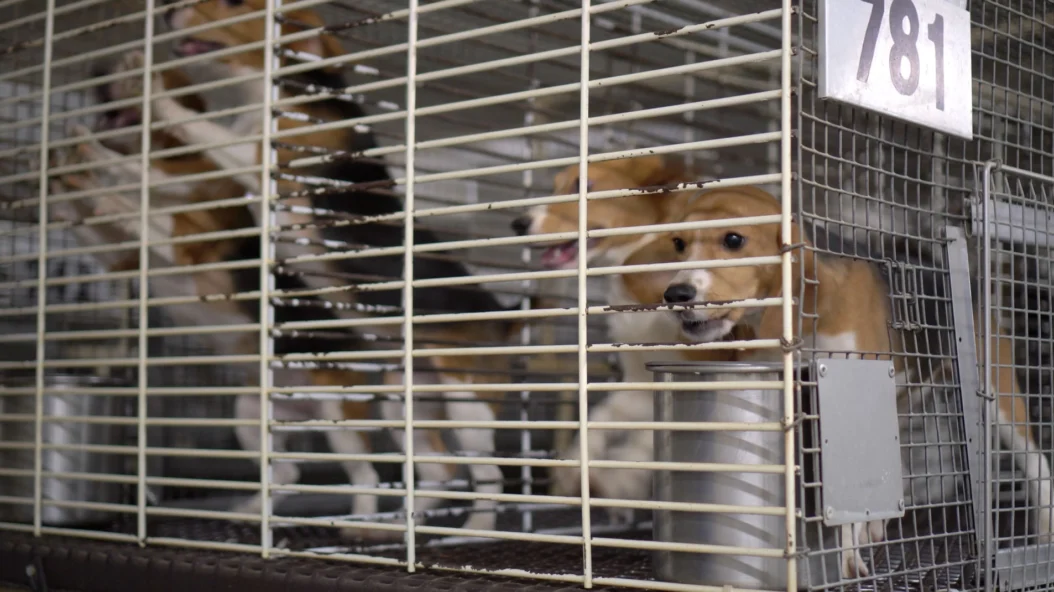
The Center led the negotiations with Ridglan Farms to release the beagles from the facility
Madison, Wis. — The Center for a Humane Economy celebrated the relinquishment of the last set of dogs from Ridglan Farms, signaling the impending closure of what was until recently the second-largest beagle supplier in the nation. The company has been in business for 60 years.
“We were pleased to have led the negotiations with Ridglan Farms to secure the first 1,635 dogs from the laboratory breeding supply company,” said Wayne Pacelle, president of the Center for a Humane Economy and Animal Wellness Action. “That negotiation was set up by our work to pass the FDA Modernization Act 2.0, which eliminated an 84-year-old mandate for animal testing in drug screening. During that legislative campaign, we closed the case that animal testing is expensive, slow, and ineffective, and that there are superior, human-relevant testing methods. Ridglan Farms would never have relinquished its animals if the animal-testing requirement had remained in place.”
Paul Collins, Wisconsin state director for Animal Wellness Action, thanked the incredible set of organizations and individuals who collaborated to pressure Ridglan Farms to shut its doors.
“The persistence and passion of animal advocates has been an essential ingredient of success,” noted Collins. “This outcome is a collective success of the animal protection movement and its desire to take beagles out of the laboratory animal pipeline.”
The organizations offered special praise to Wisconsin Special Prosecutor Tim Gruenke, whose agreement with Ridglan limited the company’s future commercial opportunities. And the organizations also offered special thanks to Joseph Goode, an attorney with Laffey, Leitner & Goode LLC, who was the lead negotiator with the attorney for Ridglan Farms.
The Timeline That Brought Us Here
October 2025
The Center for a Humane Economy joined a coalition that included Dane4Dogs, PETA, The Simple Heart, Rise for Animals, and other organizations to urge court-appointed Special Prosecutor Tim Gruenke to pursue meaningful enforcement of Wisconsin animal cruelty laws and to act regarding Ridglan Farms.
Special Prosecutor Gruenke and Ridglan Farms subsequently reached a plea agreement requiring the company to surrender its commercial dog breeding and seller’s license by July 1, 2026, in lieu of facing criminal animal cruelty charges. The importance of Mr. Gruenke’s work in securing this outcome cannot be overstated.
February 2026
Recognizing that Ridglan’s business model was becoming increasingly untenable, the Center for a Humane Economy opened private discussions with the company’s counsel about acquiring dogs to prevent them from getting permanently caught in the animal-research complex by being sold to pharmaceutical companies or other laboratory animal users.
March 2026
Animal advocate Wayne Hsiung led a major protest at Ridglan Farms, drawing participants from Wisconsin and around the country. The demonstrations elevated national awareness and increased public scrutiny of the facility.
April 2026
Big Dog Ranch Rescue (BDRR) joined the private discussions initiated by the Center for a Humane Economy about purchasing and rehoming the dogs.
As negotiations continued, Wayne Hsiung organized an even larger and more visible demonstration, generating substantial media attention and public engagement.
Late April 2026
The Center for a Humane Economy and Big Dog Ranch Rescue signed a confidential agreement with Ridglan Farms to purchase approximately 1,500 dogs to set them on a path to live with loving families. The Center worked closely with Beagle Freedom Project, the Wisconsin Puppy Mill Project, Dane County Humane Society, and the Wisconsin Federated Humane Societies to rescue, transport, and care for 500 dogs we directly acquired.
June 2026
With public interest growing regarding the dogs still at Ridglan, the Center for a Humane Economy and BDRR acquired another 135 dogs and continued placement efforts.
Ridglan’s counsel contacted the Center’s attorney and proposed the transfer of the remaining 475 dogs — 325 immediately and another 150 later this summer after completion of existing testing protocols. It was during those conversations that Ridglan’s attorney confirmed that the company would soon wind down its operations.
Ridglan Farms’ Closure Accelerates Movement to Wind Down Dog and Cat Testing
The most recent USDA figures reported approximately 42,000 dogs and more than 107,000 primates used in laboratory testing in a single year. The last goliath in the dog breeding and commercial sales space is Marshall BioResources, an international conglomerate in the lab-animal trade with an astonishing 20,000-plus beagles and tens of thousands of other animals at its facility in Wayne County, N.Y.
“Pharmaceutical companies, contract research organizations, and other institutions must stop purchasing dogs from this company,” noted Tamara Drake, director of research and regulatory affairs for the Center for a Humane Economy. “They must be asked to explain why they are injuring animals when modern alternatives, firmly grounded on human biology and superior in so many ways, are validated and ready for practical application.”
U.S. House lawmakers last month approved the FDA Modernization Act 3.0 to accelerate the transition toward modern, animal-free science by ensuring that federal regulations practically and effectively implement animal testing reform. The Senate passed that same bill in December, and it has one more small hurdle to clear before it’s enacted.
The Center for a Humane Economy and Animal Wellness Action are now working on legislation with lawmakers from both parties in both chambers to bar federal funding for research protocols that use dogs or cats in invasive experiments.