
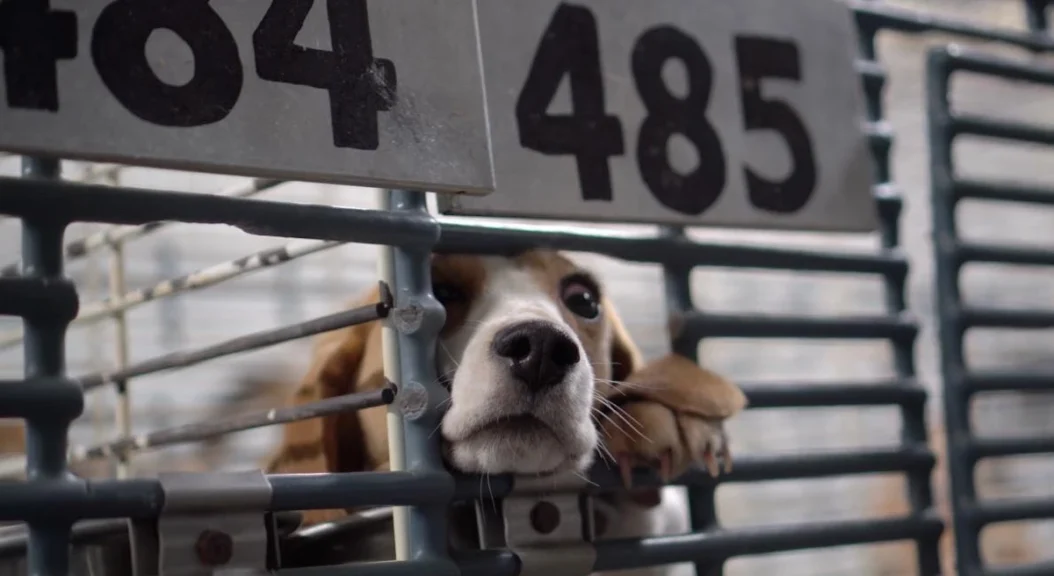
Ridglan Farms to Cease Operations
The company is releasing more dogs to rescue groups, and it will get out of the business of selling dogs to laboratories or using them in tests
- Wayne Pacelle
In the coming months, Ridglan Farms will shutter its operations. No more sale of dogs for testing. No in-house commercial testing, either.
During my recent visits to Ridglan to pick up dogs and transfer them to loving homes, employees there told me that very thing in indirect ways. Days ago, Joseph Goode, the Milwaukee-based attorney representing the Center for a Humane Economy in discussions with Ridglan Farms, received confirmation from Eric McLeod, Ridglan Farms’ attorney, that he is assisting the leadership of the company in “winding down its operation.”
Based on that exchange, we say with confidence that this major supplier of dogs to laboratories will conclude its operations after 60 years in the business.
(You can watch our video about this exchange here)
Only recently has Ridglan Farms entered the national lexicon. So this extraordinary news is not quite the same as a long-established brand like Adidas stopping the use of kangaroo skins. Or Ringling Brothers ending its wild animal circus. Or even Giorgio Armani’s fashion company is cleansing fur from its supply chain.
But it’s a major moment, given Ridglan’s big footprint on beagle sales, in the national movement to wean the nation from animal testing and to begin dismantling the architecture of the animal-research complex.
There is no singular causal factor in this success. Certainly, our work to ensure passage of the FDA Modernization Act 2.0 – eliminating an 84-year-old animal testing mandate – enabled all of this. So, too, has the emergence of new human-relevant testing methods that make animal testing look crude and archaic.
But the persistence and passion of animal advocates have been an essential ingredient of success. They exposed conditions at the facility, pressed for accountability, and demanded a better fate for the dogs. This breaking news is the culmination of those unyielding and caring efforts.
This impending outcome belongs to many people and organizations. To the scientists who understood that there are better ways. To the rescuers who loaded dogs into vehicles. To the veterinarians, vet techs, fosters, and humane organizations who gave them tender care when they were carried off the grounds. To the advocates who used their First Amendment rights to protest. To the lawyers who helped at so many turns. To the lawmakers who raised their voices. To Wisconsin Special Prosecutor Tim Gruenke, whose agreement with Ridglan limited the company’s future commercial opportunities. And especially to the donors and supporters who made the work possible.
The Ridglan beagles, in their quiet and humble way, have become unwitting ambassadors for so many other tens of thousands of dogs, more than a hundred thousand primates, and millions of other animals caught up in the animal-research complex that yields far too much suffering for the animals, and far too few results for the people the system is supposed to benefit.
The Recent Timeline That Brought Us Here
October 2025
The Center for a Humane Economy joined a coalition that included Dane4Dogs, PETA, The Simple Heart, Rise for Animals, and other organizations to urge court-appointed Special Prosecutor Tim Gruenke to pursue meaningful enforcement of Wisconsin animal cruelty laws and to take action regarding Ridglan Farms.
Special Prosecutor Gruenke and Ridglan Farms subsequently reached a plea agreement requiring the company to surrender its commercial dog breeding and seller’s license by July 1, 2026, in lieu of facing criminal animal cruelty charges. The importance of Mr. Gruenke’s work in securing this outcome cannot be overstated.
February 2026
Recognizing that Ridglan’s business model was becoming increasingly untenable, the Center for a Humane Economy opened private discussions with the company’s counsel about acquiring dogs to prevent them from getting permanently caught in the animal-research complex by being sold to pharmaceutical companies or other laboratory animal users.
March 2026
Animal advocate Wayne Hsiung led a major protest at Ridglan Farms, drawing participants from Wisconsin and around the country. The demonstrations elevated national awareness and increased public scrutiny of the facility.
April 2026
Big Dog Ranch Rescue (BDRR) joined the private discussions initiated by the Center for a Humane Economy about purchasing and rehoming the dogs.
As negotiations continued, Wayne Hsiung organized an even larger and more visible demonstration, generating substantial media attention and public engagement.
Late April 2026
The Center for a Humane Economy and Big Dog Ranch Rescue signed a confidential agreement with Ridglan Farms to purchase approximately 1,500 dogs to set them on a path to live with loving families. The Center worked closely with Beagle Freedom Project, the Wisconsin Puppy Mill Project, Dane County Humane Society, and the Wisconsin Federated Humane Societies to rescue, transport, and care for 500 dogs we directly acquired.
June 2026
With public interest growing regarding the dogs still at Ridglan, the Center for a Humane Economy and BDRR acquired another 135 dogs and continued placement efforts.
June 2026
Ridglan’s counsel contacted the Center’s attorney and proposed the transfer of the remaining 475 dogs—325 immediately and another 150 later this summer after completion of existing testing protocols.
It was during those conversations that Ridglan’s attorney confirmed that the newly conspicuous company would soon wind down its operations.
Will There Be More Progress Ahead?
Coming just four years after the 2022 closure of Envigo, a massive laboratory supplier of beagles based in Virginia, the debate about the beagles at Ridglan feels less like an isolated event and more like part of a broader transformation. The scientific and ethical foundations of animal testing are coming under increasing scrutiny, with the public no longer convinced that we must use a 1930s testing strategy nearly a century later. We are now at a moment in society when our understanding of human biology has raced ahead and where remarkable advances in artificial intelligence offer us far superior pathways for understanding disease and addressing it.
The most recent USDA figures reported approximately 42,000 dogs and more than 107,000 primates used in laboratory testing in a single year. The anticipated closure of Ridglan Farms lops off a key supplier, but the animal testing superstructure remains in place.
The last goliath in the dog breeding and commercial sales space is Marshall BioResources. This is an international conglomerate in the lab-animal trade with an astonishing 20,000+ beagles and tens of thousands of other animals at its facility in Wayne County, N.Y.
Pharmaceutical companies, contract research organizations, and other institutions must stop purchasing dogs from this company. They must be asked to explain why they are injuring animals when modern alternatives, firmly grounded on human biology and superior in so many ways, are validated and ready for practical application.
Key congressional authorizing committees should hold hearings so the public can know which companies are buying dogs and primates from these breeders. Alumni of research universities and board members of publicly traded and privately held companies must demand answers. Pharma companies will no longer be able to obscure or excuse their critical participation in this cycle of mistreatment.
And then there’s the National Institutes of Health. It remains the world’s largest funder of biomedical research. This agency doles out billions of your tax dollars to put animals into cages and under the scalpel.
Even former leaders of the agency years ago acknowledged the limitations of animal-based research.
Former NIH Director Dr. Francis Collins recognized the shortcomings of animal testing. He observed that “we are not rats and we are not even other primates” and predicted that animal-free technologies would increasingly replace animals in drug development and safety testing, delivering results that are “more accurate, at lower cost and with higher throughput.”
More than a decade ago, one of Dr. Collins’s predecessors, Dr. Elias Zerhouni, conceded that biomedical research had “moved away from studying human disease in humans” and warned that excessive reliance on animal models “hasn’t worked.” He urged the scientific community to “refocus and adapt new methodologies for use in humans to understand disease biology in humans.”
Now, Congress has an opportunity to build on the game-changing passage of the FDA Modernization Act 2.0 by enacting a critical follow-up bill. The FDA Modernization Act 3.0, which has already been passed by the full U.S. Senate and by the House committee of jurisdiction, would accelerate the transition toward modern, animal-free science by ensuring that federal regulations practically and effectively implement animal testing reform. In addition, Congress must defund any NIH grant-making for research protocols involving the use of dogs, cats, or primates.
Urge Congress to end taxpayer-funded dog and cat experiments.
Progress in winding down all animal testing recognizes a simple truth: the future of biomedical science lies not in trying to make animals mimic human disease, but in embracing human-relevant methods that are more accurate, more efficient, and more humane.
The impending closure of Ridglan Farms is an indicator that meaningful change in this difficult domain of animal testing is possible. It should buoy us as we fight on the larger front.
Thank you for standing with us and helping make this extraordinary moment possible.
Wayne Pacelle, president of Animal Wellness Action and the Center for a Humane Economy, is the author of two New York Times bestselling books, “The Bond” and “The Humane Economy.”
Dear reader: If you support substantive policy work to protect animals, please consider donating to the Center for a Humane Economy today. You can give any amount one time, or make it a monthly gift, as many of our supporters do. Thank you for helping us fight for all animals.