
House Passes FDA Modernization Act 3.0, Clearing the Way for a New Era of Human-Relevant Science
Vote brings Congress to the brink of completing an overhaul of drug development
- Wayne Pacelle and Tamara Drake
Yesterday, the U.S. House of Representatives passed H.R. 2821, the FDA Modernization Act 3.0, taking one more legislative step toward ending the outdated practice of routine animal testing in drug development and accelerating the transition to modern methods grounded in human biology.
The legislation, led by Reps. Buddy Carter, R-Ga., Nanette Barragán, D-Calif., Diana Harshbarger, R-Tenn., Rosa DeLauro, D-Conn., and Troy Carter, D-La., now returns to the Senate because of constitutional procedure, even though the Senate already passed an identical bill, S. 355, also without dissent last December. With both chambers weighing in so decisively, it’s time for the Food and Drug Administration to waste not one more minute and to align its regulations with current law and modern science.
Once the Senate gives final approval to the House-passed measure, the bill will head to President Trump for his signature. This is a milestone years in the making.
Completing the FDA Modernization Mission
In 2022, Congress passed the FDA Modernization Act 2.0, repealing an 84-year-old federal requirement that animal testing be used in the development of new medicines. But while Congress changed the law, the FDA never fully updated its regulations, leaving drug developers caught between statutory language encouraging modern methods and agency regulations still rooted in an earlier era.
The FDA Modernization Act 3.0 closes that gap. It directs the FDA to bring its regulations into conformity with the law Congress already enacted, giving scientists, regulators, and drug developers clear direction to embrace scientifically valid, human-relevant testing methods.
The House’s overwhelming support follows months of landmark progress at the FDA under former Commissioner Marty Makary, M.D. In April 2025, Dr. Makary unveiled the agency’s Roadmap to Reduce Animal Testing in Preclinical Safety Studies, signaling that the FDA is finally prepared to move beyond routine animal testing and toward technologies that better model human outcomes. He called animal testing “ineffective” and questioned the morality of continuing practices that inflict suffering on animals when better alternatives are increasingly available.
Congress Doubles Down, Signals FDA to Wind Down Animal Testing
Rep. Buddy Carter, the lead Republican sponsor of the legislation, captured the significance of today’s vote:
“The House passage of the FDA Modernization Act 3.0 marks a major step toward a more modern, effective, and humane system for evaluating medicines. My bill will help update testing practices to reduce unnecessary animal harm, remove barriers to innovative, safe, and effective non-animal testing methods, and ensure the FDA’s implementation fully reflects both the law and today’s scientific capabilities.”
Rep. Nanette Barragán, the lead Democratic cosponsor, emphasized that this legislation is about both patients and scientific progress:
“Removing outdated animal testing mandates from federal law can help get drug treatments to patients faster. The FDA Modernization Act 3.0 helps ensure federal implementation keeps up with modern scientific innovation and the growing availability of human-relevant research methods.”
Sens. Cory Booker, D-N.J., Eric Schmitt, R-Mo., and Rand Paul, R-Ky., led the parallel effort in the upper chamber. Their bipartisan work underscores that weaning the pharmaceutical industry from animal testing is a scientific imperative, a public health priority, and an animal welfare necessity.
The current system remains astonishingly inefficient. Roughly 90–95% of drugs that successfully navigate years of animal testing ultimately fail in human clinical trials. That extraordinary failure rate tells us what researchers have increasingly understood for years: animal biology often fails to model human biology.
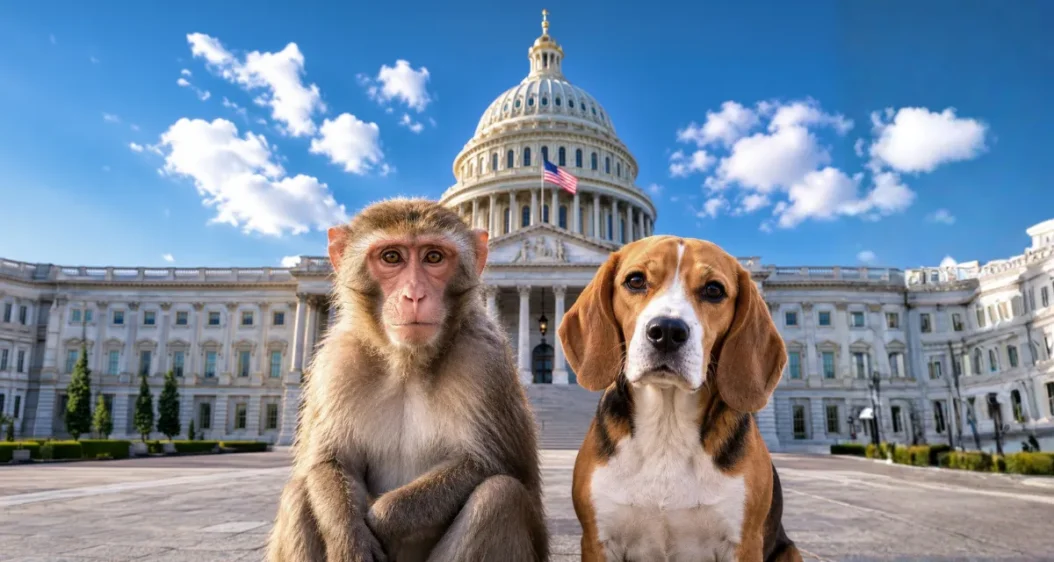
Meanwhile, hundreds of thousands of animals continue to be bred and used for experiments every year, especially in preclinical drug development. Beagles from commercial breeding facilities and primates housed in research centers continue to bear the burden of a system that is both ethically troubling and scientifically obsolete.
When we helped negotiate an end to the operations of Ridglan Farms in Blue Mounds, Wis., just weeks ago, we were attacking the problem from a different angle, convincing one of the two biggest suppliers of dogs to laboratories to halt this inhumane trade.
Technologies such as organs-on-a-chip, organoids, sophisticated computational models, and artificial intelligence can more accurately model human physiology, identify unsafe compounds earlier, reduce development costs, and bring promising therapies to patients more quickly. These methods settle the moral problem of animal mistreatment while also dramatically improving scientific outcomes.
Three years ago, many doubted Congress would ever dismantle the federal animal testing mandate that had stood for more than eight decades. Yet Congress did exactly that with the FDA Modernization Act 2.0. Today, lawmakers took the next logical step by ensuring that federal regulations finally catch up with federal law.
The Center for a Humane Economy and Animal Wellness Action have been proud to help lead this campaign from the beginning, working alongside congressional champions, scientists, patient advocates, and federal officials to modernize America’s drug development system.
One final Senate vote on the House-passed measure will send FDA Modernization Act 3.0 to the White House. When that happens, the United States will be positioned to accelerate the transition toward faster, more predictive, more humane drug development — benefiting patients awaiting new therapies while sparing countless animals from unnecessary suffering.
We eagerly wait for the Senate to repeat its action from last December and put this life-affirming legislation in front of President Trump for his signature.
Wayne Pacelle, president of the Center for a Humane Economy and Animal Wellness Action, is the author of two New York Times bestselling books, “The Bond” and “The Humane Economy.” Tamara Drake is the director of research and regulatory policy at the Center for a Humane Economy.
Dear reader: If you support substantive policy work to protect animals, please consider donating to the Center for a Humane Economy today. You can give any amount one time, or make it a monthly gift, as many of our supporters do. Thank you for helping us fight for all animals.