
Trump Administration Resurrects Archaic Poison Bombs No One Wants
The return of M-44 poison devices threatens wildlife, dogs, and people — despite overwhelming public opposition and safer alternatives
By Ted Williams
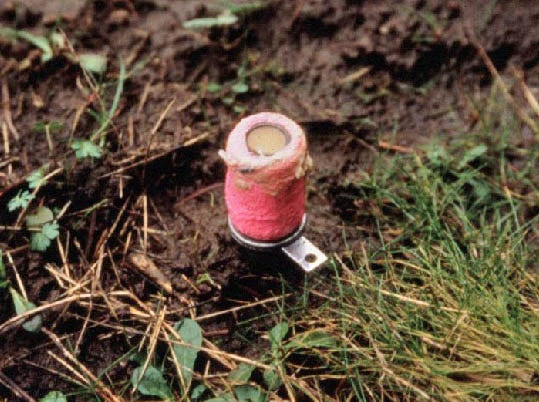
M-44s are wildlife WMDs — scented, spring-loaded devices that blast sodium cyanide into the mouth of any animal that bites and pulls them.
On April 15, the Trump administration lifted Biden’s blanket M-44 ban on 245 million acres of public land overseen by the Bureau of Land Management (BLM), proclaiming M-44s are “tools that may be considered under existing law and environmental review.” They’ll be deployed by the USDA’s Wildlife Services.
An M-44 cyanide ejector device set in the ground. The spring-loaded devices are designed to spray sodium cyanide into the mouths of animals that bite and pull the baited trigger.
Photo by Brooks Fahy, Predator Defense
M-44s are designed to kill coyotes, red foxes, gray foxes, and feral dogs that sometimes prey on sheep, poultry and newborn cattle.
But coyotes, foxes and feral dogs are not all that M-44s kill. According to Wildlife Services’ own records, they also kill at least 150 nontarget species including cattle, sheep, goats, guard dogs, bird dogs, pet dogs, grizzly bears, black bears, endangered Mexican wolves, northwestern gray wolves, bald eagles, golden eagles, falcons, other hawks, vultures, including endangered California condors, owls, ravens, crows, raccoons, opossums, skunks, sundry species of rabbits and kangaroo rats, badgers, threatened wolverines, threatened lynx, fishers and, in at least one case, humans — Dennis Slaugh of Vernal, Utah.
“I have worked since 1994 with countless people who have lost their dogs to M-44s or been poisoned themselves,” said Brooks Fahy, executive director of Predator Defense, a national wildlife advocacy nonprofit. “My experience has shown me that M-44s can never be used safely. They are indiscriminate killers, and no young child, dog or wild animal can read a warning sign. I firmly believe it is only a matter of time until an M-44 kills a child.”
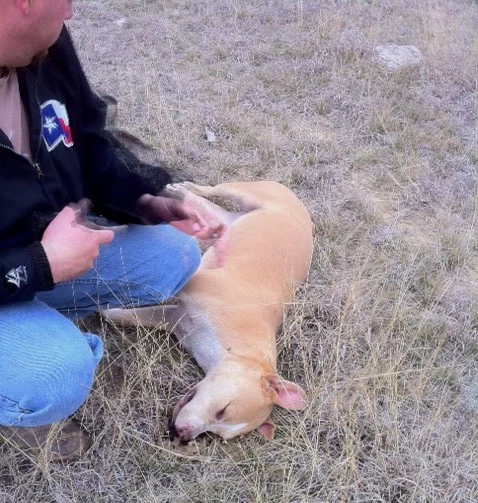
Bella, beloved pet of Angel and J.D. Walker of Bangs, Texas, killed by a M-44 set 918 feet from their house. Critics of the program say family pets and other nontarget animals are routinely placed at risk when the devices are deployed on public and private lands.
Photo courtesy of Predator Defense
M-44s have been and are used on certain state and private lands in Texas, New Mexico, Montana, Wyoming, South Dakota, North Dakota, Nebraska, Oklahoma, Nevada, and West Virginia. In Colorado, M-44s are used only on private land. Oregon, Washington, and California have banned M-44s everywhere, including on BLM lands within their borders.
But under the Property Clause of the U.S. Constitution, federal law remains supreme over state law regarding management of federal public lands. Consequently, a state cannot regulate the actions of a federal agency performing official duties on federal property unless authorized to do so by Congress. States can sue the federal government, but they must prevail in court to enforce restrictions.
In the past, BLM and Wildlife Services have respected state-level prohibitions on M-44s. By no means is it clear that the Trump administration will continue to do so.
The situation on Idaho’s 12 million acres of BLM land stands apart. In 2017, an M-44 on BLM land near Pocatello severely injured a 14-year-old boy and killed his dog. The incident elicited public outrage and a lawsuit by environmental groups. In 2020, Wildlife Services settled by imposing a temporary moratorium on M-44 use in Idaho until the agency completes an Environmental Impact Statement. At this writing, that requirement remains unfulfilled.
The Public Rejected M-44s
On August 7, 2019, Trump’s EPA reauthorized the ongoing use of M-44s on public and private lands, triggering such immediate and intense backlash from Congress and the animal wellness and environmental communities that the agency temporarily withdrew the reauthorization eight days later.
Then, during the public comment period, the EPA heard from 22,390 people. All, save 0.045% (10 individuals), opposed reauthorization of M-44s.
The Administrative Procedure Act of 1946 guarantees Americans the right to comment on federal rulemaking. What’s more, the law mandates that federal agencies consider all “relevant matter presented.”
But Trump dismisses Americans who exercise their legal right to file public comments as “obstructors.” He ignored all “relevant matter presented,” and, on December 7, 2019, reauthorized M-44s.
On November 22, 2023, President Biden banned M-44s on all 245 million acres of BLM lands, allowing their continued use on private lands. M-44s were not banned on lands managed by the U.S. Forest Service, but they’ve not been used there in recent years. The National Park Service and the U.S. Fish and Wildlife Service have traditionally prohibited M-44s.
On April 15, 2026, when the Trump administration lifted Biden’s blanket M-44 ban on BLM lands, there had been no public comment period. The administration bypassed it with an “internal memorandum of understanding” — an interagency agreement between the BLM and the USDA rather than a regulation.
The animal wellness and environmental communities are furious. Predator Defense, the first group to alert the public, issued the following statement: “In a move that should outrage all who love their children, their dogs, wildlife, and the notion that they can recreate safely on public lands, we confirmed today that the Trump administration has quietly reauthorized the use of M-44 cyanide bombs on BLM lands. This comes after we successfully got them banned on all 245 million acres of BLM lands in 2023. We will fight this tooth and nail and will be alerting you to strategic ways to express your outrage shortly.”
Camilla Fox, director of Project Coyote, called the Trump administration’s reversal “devastating and dangerous.”
And this from Wayne Pacelle, president and founder of Animal Wellness Action and the Center for a Humane Economy: “Reinstituting the use of poisonous bombs in the bush or in the desert sounds like war tactics from 1970s rebel guerrillas in Angola, and not the actions of our U.S. public lands agencies. Their statutory and moral responsibility is to steward wildlife, not poison native wild animals and lay exploding traps for them.”
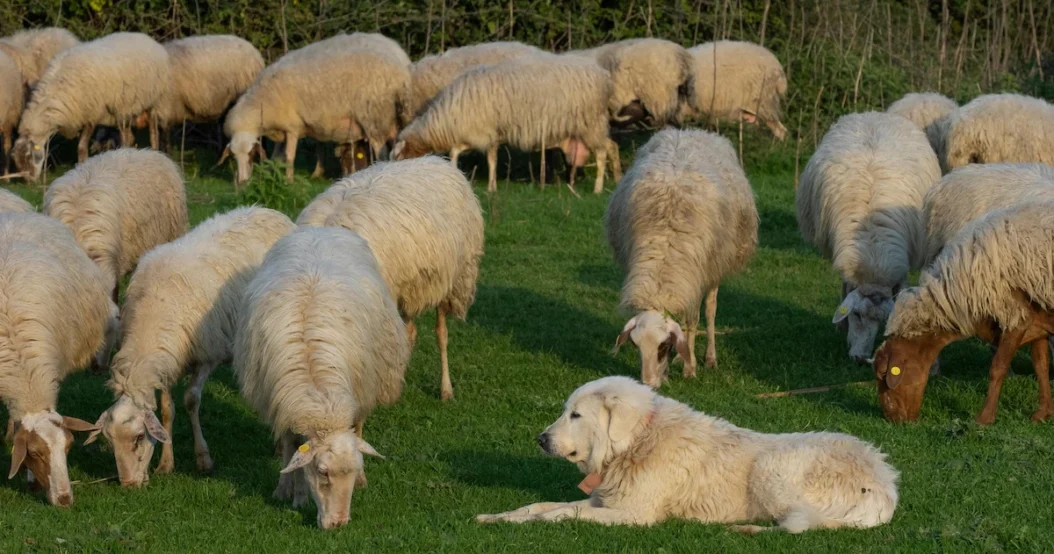
So who, other than the Trump administration, wants M-44s back on public land? I put the question to Carter Niemeyer, who worked for Wildlife Services for 26 years, supervising field agents in Montana for much of that time. Whoever it is, he explained, it isn’t today’s sheep producers, for whom M-44s were originally designed. Festooning private and public lands with poison bombs scented to attract and kill canids is the very last thing they want. That’s because the vast majority of sheep producers now use guard dogs.
“Guard dogs have dramatically reduced coyote damage,” said Niemeyer. “M-44s would be a major concern. On BLM lands, they’re a huge risk to people and dogs who have no concept that these devices are out there. As a supervisor, I found that my trappers were generally reluctant to use M-44s.”
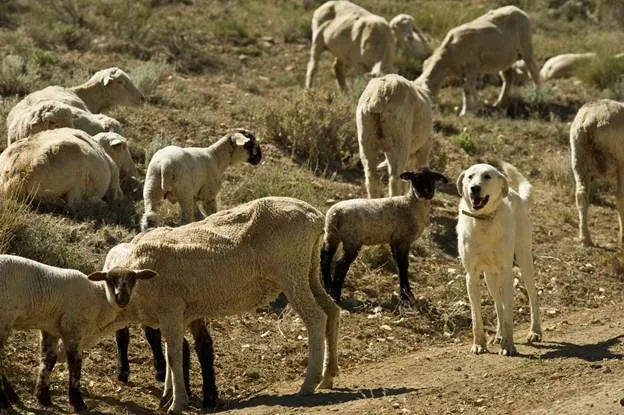
Livestock guardian dogs, such as this Kangal shepherd, are now widely used by sheep producers to deter predators without lethal control methods such as M-44 cyanide devices. Former Wildlife Services officials say many ranchers prefer these nonlethal approaches.
Photo courtesy of Wildlife Services
Niemeyer warned that M-44 cyanide devices can create serious risks on open grazing land because gates may be left unsigned or accessible to the public, potentially endangering hunting dogs, ranch dogs, and household pets. And for field agents, there are bothersome issues about accountability and tracking: devices must be locked up before deployment, and once one fires, it can be difficult to determine what animal it killed or whether the spent device was later carried away by another animal.
Why Random Killing Backfires
When Niemeyer’s field agents did use M-44s, they used them surgically to take out problem coyotes. They didn’t indiscriminately cluster-bomb open range with M-44s.
“The trouble with cyanide,” Niemeyer continued, “is that it’s unforgiving. Any animal that triggers an M-44 is dead. With traps, snares, and bullets, you can be selective. And with traps and snares, you can usually release nontarget animals.”
Niemeyer emphasizes the need for “corrective” instead of “preventive” predator control. “When we had, say, two coyotes regularly killing sheep, we’d go in and remove them,” he declared. “That’s corrective control. Preventive control is not control at all — gunships in the air every flyable day to shoot any coyote because it might eat a sheep someday.”
As Niemeyer learned in Montana, such indiscriminate killing of free-ranging predators disrupts age structures and territorial defenses so that younger, inexperienced animals that haven’t learned about dangers associated with human settlements and are more likely to cause trouble, move into range emptied of older, experienced predators.
In 2018, when I interviewed Niemeyer for a piece on coyote killing contests, he’d just returned from Boise, Idaho, where he’d given a talk on predators to Backcountry Hunters & Anglers, an outfit that despises wildlife killing contests and promotes fair-chase hunting instead.
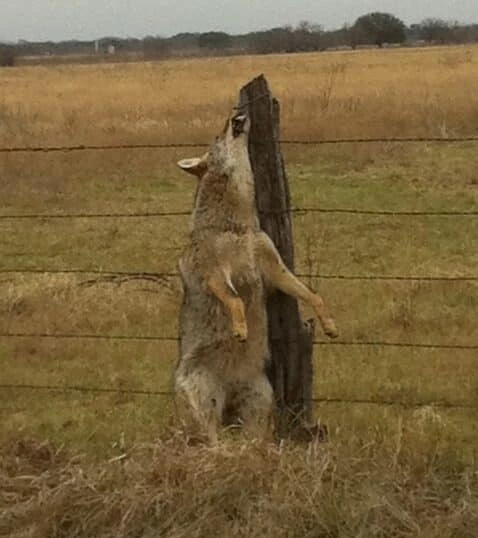
A coyote killed after exposure to an M-44 cyanide device. Wildlife experts quoted in the article argue that indiscriminate predator killing can destabilize ecosystems and increase conflicts with livestock.
Photo courtesy of Predator Defense
“They were extremely receptive,” he said. “I told them about the time in Montana we sent in a helicopter and randomly shot a bunch of coyotes. The rancher called me a couple days later and said, ‘Carter, do coyotes revenge kill? We haven’t had trouble with coyotes all winter. We saw your helicopter the other morning and heard lots of shooting. Now we’ve got coyotes killing sheep. What the hell’s going on?’ When you have coyotes eating rodents and rabbits around sheep, that’s desirable. Random killing — ‘preventive control’ — creates chaos, removing the good coyotes. So other coyotes immediately come in to fill the void, and some may be undesirables.”
But random killing, now reauthorized by the Trump administration, is precisely what will be happening on BLM land.
“You can’t control coyotes with M-44s,” said Niemeyer. “You can randomly kill them, but because of natural dispersal, it’s like playing musical chairs. If you look at national statistics, it’s obvious that preventive coyote control doesn’t work. Some states kill five to nine thousand coyotes a year. Killing hundreds of coyotes for the loss of one sheep is senseless. You can kill coyotes forever, and there will always be more coyotes.”
Instead of reducing coyote numbers, the Trump administration’s lifting of Biden’s blanket M-44 ban will increase them. And because of the chaos caused by random killing, many of the survivors will be problem coyotes.
Dr. Robert Crabtree, America’s leading researcher on coyotes, found that virtually all preventive coyote control results in more, not fewer, coyotes. Reduction is possible only if 70% of a population is killed, something Crabtree notes “rarely if ever happens.”
In populations unmolested by humans, the average litter size at birth is five or six. But competition in summer reduces pup survival to 1.5 to 2.5. So when humans randomly kill coyotes, reduced competition results in higher survival.
And Crabtree has determined that because preventive coyote control reduces the number of adults able to feed young, coyotes tend to abandon their normal diet of rabbits and rodents, turning instead to larger prey like sheep, antelope, and deer.
Canyon’s Law and the Human Cost
A bill to ban M-44s on public lands has been introduced in multiple sessions of Congress — most recently as H.R. 4180 and S. 2179. It has consistently garnered bipartisan support from Congress and endorsements from animal welfare and environmental organizations. But it hasn’t been able to move past the committee stage for a full floor vote. Now, because of the Trump administration’s resurrection of M-44s on public lands, it has a chance. All wildlife and pet advocates need to implore their legislators to support it.
Canyon Mansfield and his dog, Kasey, before the 2017 M-44 poisoning incident near Pocatello, Idaho. Kasey was killed and Canyon was injured after triggering a cyanide device placed on public land.
Photo courtesy of the Mansfield family.

The bill is called “Canyon’s Law,” after Canyon Mansfield from Pocatello, Idaho. In March 2017, when he was 14, Canyon encountered an M-44 on BLM land behind his house. He thought it was a sprinkler head. When he picked it up, his 3-year-old yellow Labrador, Kasey, got hit in the muzzle and died in agony over a period of about 15 minutes. Some of the cyanide hit Canyon in the face, damaging his eyes. But he was spared death by wind, which blew some of the toxic cloud away from his mouth.
On July 21, 2022, physician Dr. Mark Mansfield, Canyon’s father, presented the following testimony to the House Natural Resources Subcommittee on Water, Oceans, and Wildlife:
This M-44 cyanide bomb, set by the U.S. Department of Agriculture’s Wildlife Services program, stole a cherished member of my family, an irreplaceable piece of my son’s innocence, and my entire community’s sense of security… Canyon experienced excruciating headaches for over a month, all day and through the nights without relief for five weeks with nausea, vomiting, numbness in his hands, and crushing insomnia. We did everything we could to bring him comfort, but there are no tests for a sublethal dose of sodium cyanide and there is no effective treatment for the irreversible physical effects of cyanide poisoning, much less the accompanying emotional and psychological trauma.
Canyon suffered from symptoms of chronic cyanide poisoning until he graduated high school. It’s unclear if there is permanent damage.
Ted Williams, a lifelong hunter, writes exclusively about wildlife. He is a former information officer for the Massachusetts Division of Fisheries and Wildlife and currently serves on the Circle of Chiefs of the Outdoor Writers Association of America.