
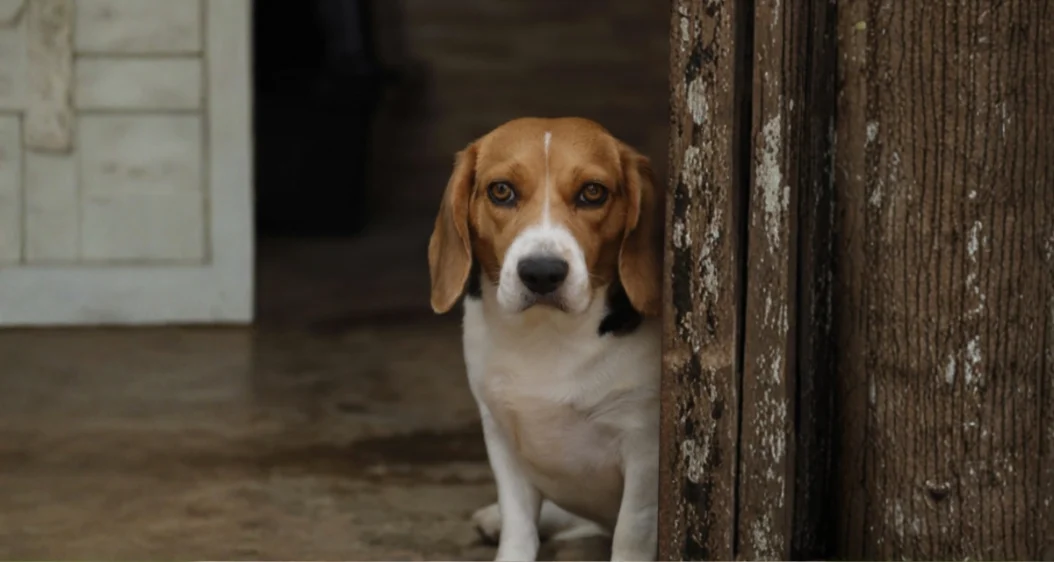
Ending Federal Funding for Invasive Tests on Dogs and Cats
The COMPACT Act builds on the historic closure of Ridglan Farms as HHS accelerates the federal shift toward human-based science.2.0.
- Wayne Pacelle
More than a decade ago, I worked with Dr. Jane Goodall, then NIH Director Francis Collins, and then U.S. Fish and Wildlife Service Director Dan Ashe to end the use of chimpanzees in invasive experiments. Even though chimpanzees are our closest living relatives on the phylogenetic tree, they proved unreliable as tools for research for human welfare.
It’s time now to end the use of our closest family members in the animal kingdom. Today we announce that we have a plan to achieve that goal. Like chimps, dogs and cats are not good at forecasting medical responses to human disease.
This afternoon, with my colleague Zaher Nahle, PhD., MPA, I joined U.S. Reps. Nick Langworthy, R-N.Y., and Mark Pocan, D-Wis., at a press conference in the shadow of the U.S. Capitol to announce the introduction of the Companion Animal Protection Against Cruel Testing (COMPACT) Act, H.R. 10522.
This bipartisan legislation would end Department of Health and Human Services (HHS) funding for biomedical experimentation involving live dogs and cats, while preserving research intended specifically to improve the health of dogs and cats. Original cosponsors include Reps. Mike Quigley, D-Ill., Randy Fine, R-Fla., Debbie Wasserman Schultz, D-Fla., Dina Titus, D-Nev., Veronica Escobar, D-Texas, Del. Eleanor Holmes Norton, D-D.C., Jeff Van Drew, R-N.J., and Anna Paulina Luna, R-Fla.
The legislation comes as we build momentum in our broader efforts to replace the use of animals in drug development and other medical uses with cutting-edge technology grounded in understanding human biology.
Major Progress Announced This Week from U.S. Public Health Agencies
This week, HHS announced a coordinated, department-wide effort to accelerate human-based research and reduce reliance on animal testing. More than 20 initiatives across the Food and Drug Administration, National Institutes of Health, Centers for Disease Control and Prevention, and Advanced Research Projects Agency for Health are aimed at modernizing how the federal government conducts, funds, and evaluates biomedical research.
The COMPACT Act carries that modernization principle into federally funded dog and cat research.
It also builds on our work to negotiate the release of 2,115 beagles from Ridglan Farms in Wisconsin this past spring and summer.
That release followed years of controversy surrounding conditions at Ridglan, including a judicial finding of evidence of animal mistreatment at the nation’s second-largest supplier of beagles to laboratories.
It was a major moment in our movement for the compassionate treatment of animals when Ridglan shut down its beagle-use operations just weeks ago.
COMPACT Act Will Accelerate the Wind-Down of Animal Testing
Under the COMPACT Act, no funds from the U.S. Department of Health and Human Services (HHS) can be used to support the purchase, breeding, housing, transportation, or experimental use of dogs and cats in covered biomedical research, including costs that materially facilitate those experiments. The bill, H.R. 10522, also includes provisions to facilitate adoptions of dogs and cats used as part of existing protocols.
Human-derived cells and tissues, induced pluripotent stem cell systems, organoids, organ-on-chip technologies, computational modeling, artificial intelligence, and other New Approach Methodologies (NAMs) are increasingly giving researchers tools to investigate human biology and disease directly.
Congress helped accelerate this transformation when it enacted the FDA Modernization Act 2.0, led by Sens. Rand Paul, M.D., R-Ky., and Cory Booker, D-N.J., and Rep. Vern Buchanan, R-Fla., which eliminated in 2022 the longstanding statutory animal testing mandate for new drug development and explicitly opened the regulatory pathway to modern alternatives.
Also at our urging, Congress continued that work with the FDA Modernization Act 3.0, bipartisan legislation designed to ensure that the FDA’s regulations fully reflect the changes Congress made in 2.0. The measure passed the Senate in 2025 and the House this year, underscoring strong bipartisan support for completing the transition Congress began four years ago. Sens. Booker and Eric Schmitt, R-Mo., and Reps. Buddy Carter, R-Ga., and Nanette Barragán, D-Calif., are the leaders of those companion bills.
Recognizing the congressional consensus and their own interest in moving away from animal testing, the FDA and HHS announced this week a rule to adopt all the core provisions of the FDA Modernization Act 3.0. That’s one more major moment in our roster of achievements in this policy area.
HHS also announced a coordinated, department-wide effort to accelerate human-based research and reduce reliance on animal testing, bringing together more than 20 initiatives across the FDA, NIH, CDC, and ARPA-H. NIH is investing more than $88 million in biomedical infrastructure to support human-based science, establishing a new laboratory at the NIH Clinical Center integrating human organoids, robotics, and artificial intelligence, recruiting grant reviewers with expertise in human-based science, and seeking public input on annual reporting of vertebrate animals used in NIH-funded research.
These investments build on NIH’s $150 million commitment from earlier this year to develop and scale human-based research methods.
What Taxpayers Are Funding — and What We Don’t Know
According to USDA laboratory inspection reports, there were 42,026 dogs, nearly all beagles, and 12,632 cats used in or held for medical testing in 2025. Yet dogs and cats have limited value for predicting human outcomes because important differences in genetics, physiology, metabolism, and disease biology can make results difficult to translate to people. In many areas where dogs and cats have traditionally been used — including drug safety and toxicity testing — human-based methods can provide information that is more directly relevant to human biology.
While there is no official federal accounting of how much taxpayer money is spent on animal research, the COMPACT Act could save U.S. taxpayers as much as $1.5 billion over the next 10 years.
Ending the Era of Testing on Dogs, Cats, and Primates
Earlier this month, I spoke at the front end of a 207-mile March to Abolish Animal Testing across New York. And I’ll be there this weekend when the march culminates at Marshall BioResources, now the nation’s last major commercial supplier of purpose-bred dogs.
Changing the system that feeds the laboratory-animal-use industry is one prong in our coordinated efforts to dismantle a broken drug development system built on the mistreatment of animals.
Please swing behind our efforts to drive these changes. It’s all so consequential, with our work offering the prospect of wiping out abuse and ushering in a brighter future for so many millions of animals in the years ahead.
Wayne Pacelle, president of the Center for a Humane Economy and Animal Wellness Action, is the author of two New York Times bestselling books, “The Bond” and “The Humane Economy.”
Dear reader: If you support substantive policy work to protect animals, please consider donating to the Center for a Humane Economy today. You can give any amount one time, or make it a monthly gift, as many of our supporters do. Thank you for helping us fight for all animals.