
China’s Smithfield Foods Faces Steep Path in Trying to Overturn American Elections
The former leader of the Save Our Bacon (SOB) Act in the U.S. Senate withdraws support for it
- Wayne Pacelle
For more than a decade, the architects of the Save Our Bacon Act have persistently tried to persuade federal lawmakers and federal judges to overturn state animal-welfare laws approved by voters. The courts turned them back in 23 of 23 cases. And federal lawmakers rejected their amendments to the Farm bills in 2014 and 2018.
They’ve been back at it in the 119th Congress, but they’ve just sustained a devastating setback. Their former leader, U.S. Sen. Roger Marshall, R-Kan., has withdrawn his support for the legislation. And that follows the public statements of Senate Agriculture Committee Chairman John Boozman that he will omit the provision from the Farm bill he presents to the committee because no Democrats support it and a significant number of Republicans also dislike it.
This level of bipartisan opposition — which now grows with Sen. Marshall’s withdrawal of his support — should not surprise anyone.
The legislation asks Congress to do something extraordinary: nullify the votes of millions of Americans who approved farm-animal welfare standards at the ballot box. California voters approved Proposition 12. Massachusetts voters approved Question 3. Together, more than 10 million Americans cast ballots in favor of these measures after vigorous public debate about extreme confinement of animals used in agriculture.
When opponents challenged these laws, they took their case all the way to the U.S. Supreme Court. There, a conservative majority upheld California’s law as a constitutional exercise of state authority. The nation’s highest court rejected the notion that states must surrender their authority to establish humane-treatment and food-safety standards within their borders.
It’s been a bad run for Big Pork.
Supporters of the SOB Act lost at the ballot box five times in a row. They lost time and again in the federal courts. And now, after all that, they’re asking Congress to give them a third bite at the apple. Enough is enough.
The House Agriculture Committee chairman inserted the SOB provision in his version of the Farm bill, and then worked to deny the full House a vote to strip it — a certain outcome because his Save Our Bacon Act provision had just 23 cosponsors in a chamber with 435 lawmakers.
And while the National Pork Producers Council and China’s Smithfield Foods are big-money operators, their coalition of actively engaged agribusiness operations was modest. Thousands of rank-and-file pig farmers, along with many of the biggest companies in the space, are on the record in opposition to the SOB Act.
Marshall’s Reversal Exposes the SOB Act’s China Problem
Marshall was not a casual supporter of the legislation. In the 118th Congress, he authored the Senate version of the Save Our Bacon Act and was among its most prominent advocates.
The senator is from the rural western part of Kansas and he understands the livestock industry. He also understands the politics of farm legislation. He wants a Farm bill enacted, and he recognizes what many lawmakers increasingly see: the Save Our Bacon Act is a drag on forward progress for the legislation and anything but jet fuel for it.
Marshall is also hearing from producers who do not want Congress to undercut their investments in more humane housing systems that allow them to access important new markets.
That reality is often lost in discussions about Proposition 12 and Question 3. Opponents routinely suggest that these measures are forcing farmers nationwide to rebuild their operations. But the facts tell a different story.
The truth is, the pork industry already possesses more than sufficient capacity to serve California and Massachusetts without requiring producers in Iowa, Kansas, North Carolina, or any other state to undertake pig-housing changes.
The transition away from gestation crates did not begin with Proposition 12. It began more than two decades ago, when Florida voters approved the nation’s first ballot measure restricting the use of gestation crates for breeding pigs. Since then, producers have steadily diversified their housing systems in response to consumer demand and market opportunities.
Today, approximately 40% of American breeding sows are housed in group systems rather than immobilizing gestation crates. That percentage far exceeds what’s needed — about 6% of production — to supply the California and Massachusetts markets with gestation-crate-free fresh pork.
And despite endless claims that these two state laws somehow shut producers out of markets, conventional pork from animals raised in gestation crates remains eligible for sale in virtually every domestic and international market. Out of 189 markets available to American pork producers — 50 states and 139 foreign nations — 187 remain fully open to pork produced from animals confined in gestation crates.
[This is not a debate about eliminating markets.
It is a debate about preserving a market for consumers want to steer clear of meat from extreme confinement systems and for farmers who have invested handsomely in housing systems to satisfy that demand.]
The SOB Act Has United Animal Advocates and Farmers
Thousands of producers have invested hundreds of millions of dollars in upgraded housing systems because consumers, retailers, and food-service companies signaled that animal welfare matters. Those producers include family farmers, independent cooperatives, and some of the largest companies in the industry.
Niman Ranch and its network of hundreds of independent farmers have opposed congressional efforts to overturn these laws. Clemens Food Group, one of the nation’s largest pork producers, has invested heavily in alternative housing systems. Even companies that criticized Proposition 12 have nevertheless chosen to participate in the California market because consumers are willing to reward producers who meet those standards.
The Save Our Bacon Act would punish adaptation and innovation while rewarding those who chose not to respond to changing market conditions.
The measure also raises troubling questions about foreign influence in American agriculture.
Smithfield Foods, owned by Chinese interests following the acquisition of America’s largest pork producer 13 years ago, already controls roughly 25% of U.S. pig production. The company has been among the strongest forces pushing Congress to overturn state animal-welfare laws.
Americans should ask a simple question: Who benefits if Congress wipes away state safeguards and strips voters of their ability to establish basic standards for products sold within their own states?
China has already pioneered massive, multi-story pig-production facilities, including high-rise operations that house hundreds of thousands of animals in vertically integrated production systems. If Congress prevents states from establishing even modest animal-welfare standards, it becomes easier for the largest and most consolidated players in the industry to push American agriculture toward even more intensive production models.
Meanwhile, public opinion continues moving in the opposite direction.
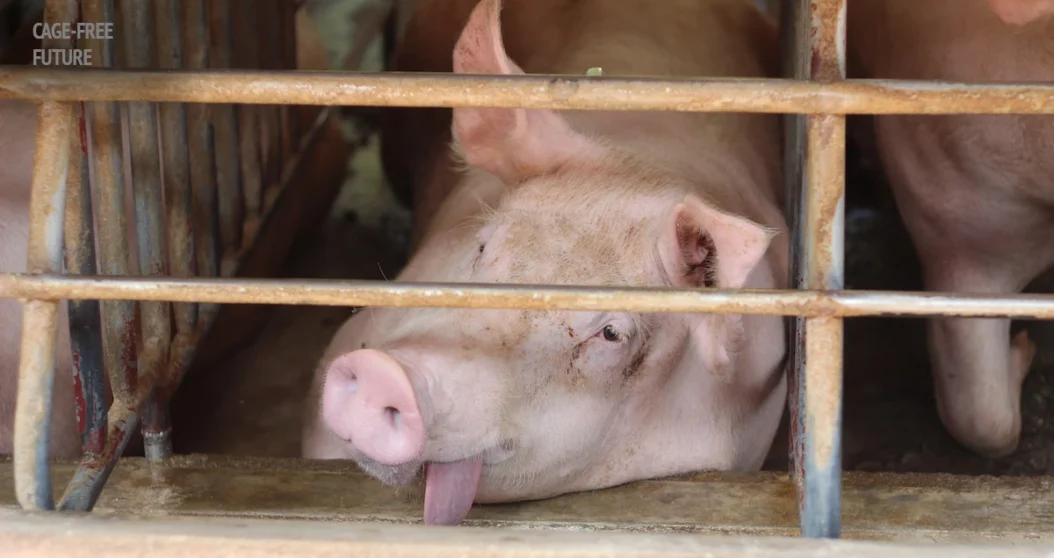
Americans overwhelmingly oppose confining breeding pigs in crates so small that the animals can scarcely turn around. The movement against gestation crates is no longer confined to a handful of states. Ohio recently joined the growing list of states that have restricted the practice, bringing the total to 11 states with anti-gestation-crate policies.
And more than 60 major food retailers, restaurant chains, and food-service companies — including McDonald’s, Costco, and Safeway — have announced policies moving away from pork sourced from gestation-crate systems. Together, these companies account for the overwhelming majority of food sales in the United States.
The message could not be clearer: consumers oppose extreme confinement, retailers oppose extreme confinement, voters oppose extreme confinement. Thousands of producers have adjusted their practices to meet that demand. Courts have upheld the right of states to establish standards reflecting those values.
Yet supporters of the Save Our Bacon Act continue to ask Congress to sweep all of that aside.
The Senate appears unwilling to oblige. Apparently, rational argument, common sense, and humane treatment principles can indeed still win the day in Congress.
Congress should not let Smithfield and Big Pork erase voter-approved animal-welfare laws. Tell your senators to reject the SOB Act.
Wayne Pacelle, president of the Center for a Humane Economy and Animal Wellness Action, is the author of two New York Times bestselling books, “The Bond” and “The Humane Economy.”
Dear reader: If you support substantive policy work to protect animals, please consider donating to the Center for a Humane Economy today. You can give any amount one time, or make it a monthly gift, as many of our supporters do. Thank you for helping us fight for all animals.