
The Fight to Close America’s Largest Dog Breeder for Lab Tests
Advocates are trekking over 200 miles, from Albany, N.Y., to the doorstep of Marshall BioResources.
- Wayne Pacelle
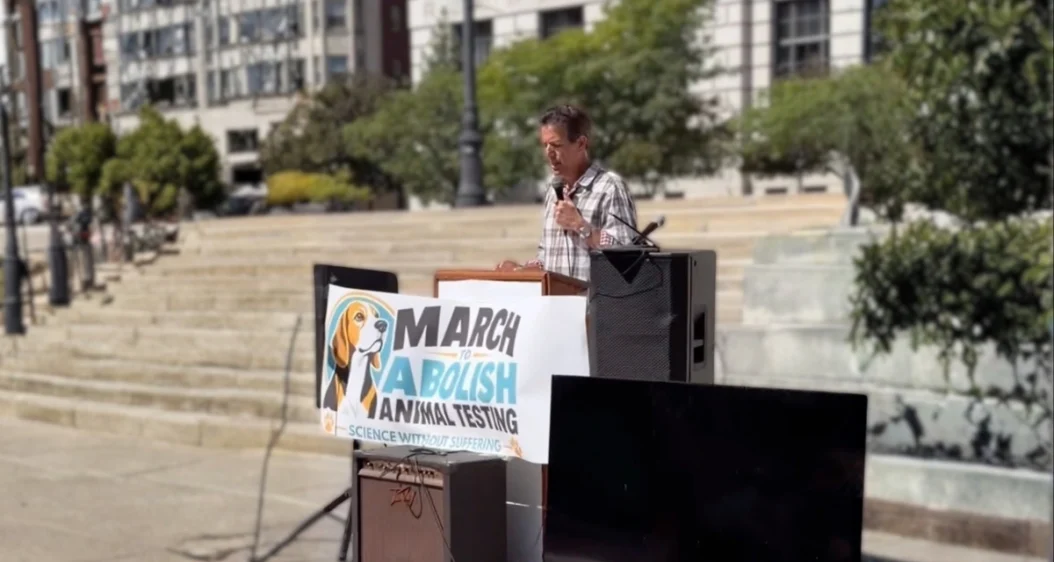
On Saturday, I stood on the steps of the Capitol in Albany, N.Y., and looked out at a crowd preparing to walk 207 miles west. Their destination was a hamlet in Wayne County, far from anywhere and home to the nation’s largest remaining supplier of dogs to laboratories — Marshall BioResources, where beagles are confined in a complex of long, low-slung buildings.
At defining moments in our history, when conscience demanded a fresh look at convention, Americans marched. Whether it was abolition or civil rights or for some other cause demanding redress of unfairness or injustice, people gathered in the community square, collectively raised their voices and protest signs, and demanded that we do better as a nation.
In the wake of the freeing of the dogs at Ridglan Farms — the Wisconsin laboratory supplier we helped to shutter this summer after first emptying its cages — the time has come for a discerning look at the horrible business of breeding beagles for invasive and often deadly tests in laboratories.
That look inevitably leads us to the front stoop of Marshall BioResources, the undisputed giant in breeding beagles and other animals for lab use.
It’s deeply saddening to anyone with a conscience that millions of animals are caught up in laboratory breeding facilities and factory farms. These are places of privation. There is no way out for the animals.
The people who run these houses of pain count on that. They count on the problem of systemic animal mistreatment being so big and overwhelming that decent people feel helpless to stop it.
The marchers in New York are on their way to prove them wrong. They are trekking across upstate New York to demand the release of tens of thousands of dogs, cats, ferrets, and pigs from Marshall.
You can watch my speech here, where I remind the marchers that millions of Americans are cheering them on.
Animal Testing Is a Failed Drug Screening Process. But Marshall Is Sticking With It
Marshall BioResources is operating an obsolete business model.
For 84 years, federal law required that new drugs — whether to address pain, cancer, obesity, or any other human malady — be tested on animals before the stage of human clinical trials. In 2022, Congress ended that requirement with the FDA Modernization Act 2.0, a reform the Center for a Humane Economy and Animal Wellness Action formulated and shepherded to passage.
Today, public health agencies, including the FDA and NIH, are investing tens of millions in alternative methods grounded on human biology, such as organoids, organs-on-chips, computational modeling, and AI. Those alternative systems are superior to animal models, which have yielded a regulatory system in which more than 90% of all experimental drugs fail when they reach human clinical trials.
Nine out of 10. If a bridge builder failed nine times out of 10, we would not call that person an engineer. The better label would be saboteur. We would call it a scandal. If a high school or pro quarterback failed in nine of 10 pass attempts, he’d get a one-way ticket out of the stadium.
USDA records show Marshall holding nearly 16,000 dogs, 2,058 cats and kittens, 13,959 ferrets, and 2,108 pigs — 10 times what Ridglan Farms ever held.
Ridglan’s fate presages Marshall’s future. After six decades, the Wisconsin-based facility surrendered its license and closed for good. The Center led the negotiations that freed all 2,115 dogs.
Everyone said that fortress could not be breached. But their freedom was secured.
Join the Fight on September 26
The marchers are, as I write this, following the old Erie Canal — a ditch every reasonable person of its day called impossible to construct. But in the 19th century, it was dug by ordinary hands and is a marvel of human labor and ingenuity. The “impossible” became possible due solely to human purpose and concentration.
It is not hard to imagine a day when we replace dogs, cats, and other animals with 21st-century scientific methods. The FDA has been relying on animal tests since the Great Depression. That system has been a colossal failure, with high drug prices, a dizzying array of adverse reactions to unsafe drugs, and so many diseases that still have no cures or treatments.
Join us at Marshall BioResources on Saturday, September 26. If you can’t come, share this video and tell at least one person about the 20,000 dogs and cats still waiting.
And please give.
Ridglan did not close because we asked politely. It closed because, when the moment came, we had the resources to get the dogs out and to place them in safe settings. When Marshall’s moment comes — and it will — we intend to be ready, at 10 times the scale.
We closed Ridglan.
Marshall is next.
We will go away only when the cages are empty.
We’ll get there faster, and with the result we want, only with your help.
On to Marshall.
Wayne Pacelle, president of the Center for a Humane Economy and Animal Wellness Action, is the author of two New York Times bestselling books, “The Bond” and “The Humane Economy.”