
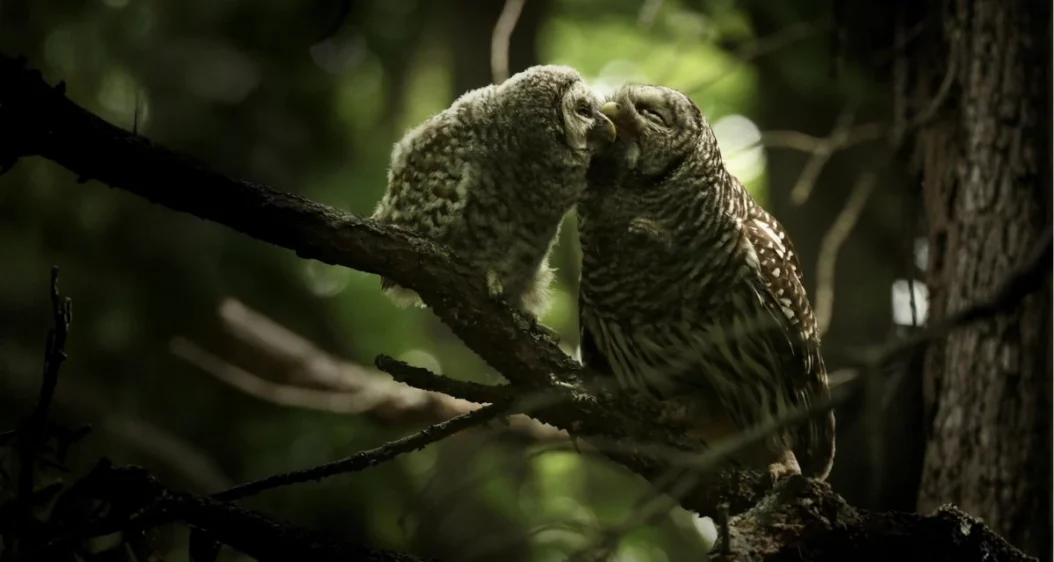
Our Court Clash with the Fish and Wildlife Service Over Its Unworkable, Inhumane, Diabolical Scheme to Kill North American Forest Owls
This is a public-private avian predator control to unlock cutting of old-growth forests
- Wayne Pacelle
This week, we are in federal court, challenging a startlingly incomplete and deficient U.S. Fish and Wildlife Service plan — dubbed the “Barred Owl Management Strategy” (BOMS) — to kill approximately 450,000 North American barred owls, purportedly to protect threatened northern spotted owls.
“Although it calls itself a ‘strategy,’ in reality, the Program is a shot in the dark, with potential adverse impacts on spotted owls and other species that the FWS fails to meaningfully evaluate,” write our attorneys in a pleading to the court. “Instead of describing a scientifically grounded conservation intervention with specific actions, measurable outcomes, and a clear pathway for success, the Program opens the door for the haphazard killing of barred owls, in unpredictable but potentially immense numbers, at unspecified locations within a vast range, at an unknown pace and frequency, for an indeterminate period lasting up to 30 years.”
This federal government plan purports to shoot barred owls to spare spotted owls from competition for their nesting sites in mature redwoods, Douglas firs, and other cathedral-like trees in the Pacific Northwest and California.
It’s a predator-control effort through and through. The shooting of barred owls will happen mostly on our public lands, including in 17 national forests and in 14 National Park Service units, including Yosemite National Park, Crater Lake National Park, and Olympic National Park. It’s a scheme unprecedented in scale, with the government seeking to police barred owl movements across 24 million acres — from southern California to the U.S. border with Canada.
The government can pay contract shooters all day long to shoot barred owls, but it will make little difference according to wildlife scientists (see a few of those letters here, here, and here). Keeping spotted owls and barred owls away from each other is spitting into the ocean and trying to change the tides. Shooting projects for barred owls will have only the most fleeting effect, with surrounding barred owls replacing them and filling the void in short order.
It’s an avian predator control plan without any chance of hitting its spotted owl conservation marks.
The Plan’s Hidden Purpose: Killing Spotted Owls, Too
The Barred Owl Management Strategy is cast by its architects as a regrettable rescue mission for the threatened northern spotted owl: shooting one forest owl to save a different forest owl.
But it turns out that the barred owl killing plan amounts to a thinly veiled cover for the timber industry to vastly expand the annual cut of timber in the verdant forests of the Pacific Northwest over the next eight years, putting both species of owls in the crosshairs. The bottom line: dramatically expanded timber-cutting in Pacific Northwest forests only happens if the BOMS plan survives our legal challenge.
The plan, backed by this Interior Department, will allow “incidental take permits” for spotted owls only because the agency is blessing the shooting of barred owls as a “mitigation” strategy — all memorialized in the BOMS.
Under the direction of Interior Secretary Doug Burghum, the plan will enable logging in spotted owl habitat, with Section 50301 of H.R. 1, the One Big Beautiful Bill Act, driving timber cutting on national forests and Bureau of Land Management (BLM) areas in the West — with the goal of increasing annual harvest by 60%, from 3 billion board feet to 5 billion board feet.
The prohibition on the killing of spotted owls under the Endangered Species Act has always presented a problem for the timber industry, long requiring industry players to plead with the FWS for permits to “take” spotted owls by devising creative ways to try to mitigate the harm to the species when they cut down the trees they live in.
Those tailored pleadings are no longer needed because the BOMS scheme creates a permanent “mitigation” tool that allows the FWS, the timber industry, the BLM, and the U.S. Forest Service to use barred owl killing as mitigation for expanded public-lands timber harvests that will necessarily kill spotted owls, especially in the old-growth forests that the spotted owls require to survive.
The interagency administrative rulemakings, including the BOMS, have been tied to a public relations plan by the government and the timber industry to smear the reputation of barred owls — falsely labeling the North American owls as “invasive,” even though the birds live only in North America. These birds, protected in North America since the adoption of the Migratory Bird Treaty Act of 1918, have engaged in a very modest range expansion over the last 150 years, along with hundreds of other bird species adapting to human impacts on forests, grasslands, and the atmosphere.
In fact, as early as 2016, a BLM Resource Management Plan stated that it would not authorize expanded timber cutting in old-growth forests — which would cause the death of threatened northern spotted owls — until a barred owl management program had been approved. BLM and the U.S. Fish and Wildlife Service — at the instigation of the timber industry — sowed the seeds for this scheme to kill barred owls and spotted owls nearly a decade ago.
Not Seeing the Forest for the Trees
Any person with any serious-minded touch with spotted owl conservation understands that it was decades of timber cutting that triggered a long-term decline in their populations. And in the present day, it’s indisputable that the timber industry’s fingerprints are all over the BOMS scheme. Indeed, it was the timber industry that funded and used industry researchers to provide the predicate studies that the agency now relies on to support the slaughter of barred owls under the guise of spotted owl conservation.
To be sure, the BOMS plan amounts to a novel weaponizing of the Endangered Species Act, turning a federal law designed as a shield for wildlife into a sword. But it’s a sword wielded not only to hurt barred owls, but spotted owls, too. Environmental organizations supporting the kill plan cannot seem to follow the trail, and their inability to understand that they are being played by the timber industry and the Interior Department is jarring.
Some conservative groups and their allies in Congress are also exhibiting knee-jerk political responses to the idea of shutting down barred owl killing and not seeing the larger context here. Once the federal government embarks on this novel use of the ESA to manage social relationships between native species in ecosystems, it will usher in a new era of federal spending and federal engineering.
There are 1,300 listed threatened and endangered species, and every one of them faces competition from other species. This might be the first of more than a thousand management wildlife-killing strategies that single-species-focused environmental groups would advocate for in the future to reduce native species impacts on threatened or endangered species.
It’s wrong for our nation to subordinate all of our other core values, including humane treatment of wildlife, to protecting threatened species. Competition between species is at the core of any ecological system. Our playing God by favoring one native species over another one is arrogant and unworkable. We step onto this terrain, and we’ll sink in the quicksand.
Our Federal Lawsuit Can Ground the Kill Plan
If the court case goes our way, the action will allow the FWS to get back to conservation basics: protecting habitats, engaging in sound forestry practices, and sensible management of forests to preserve owls who rule the night.
Nixing the BOMS will prevent the shooting of barred owls in 14 national parks and it will prevent a timber-industry assault on threatened spotted owls and their habitats, too — preventing the swamping of already depressed timber market with more wood products. It’ll also rein in an expansive use of the ESA that lawmakers never intended — preventing the opening of a new and massive federal spending spigot.
Congress, too, should step off the sidelines. Committing taxpayers to decades of spending for this plan — and creating a precedent to expand the scope of ESA “recovery” actions — will drive up our deficits and cannibalize conservation programs.
Connect the dots. Leave the owls alone.
Tell your lawmakers to oppose this reckless plan to kill 450,000 barred owls!
Wayne Pacelle, president of the Center for a Humane Economy and Animal Wellness Action, is the author of two New York Times bestselling books, “The Bond” and “The Humane Economy.”
Dear reader: If you support substantive policy work to protect animals, please consider donating to the Center for a Humane Economy today. You can give any amount one time, or make it a monthly gift, as many of our supporters do. Thank you for helping us fight for all animals.