
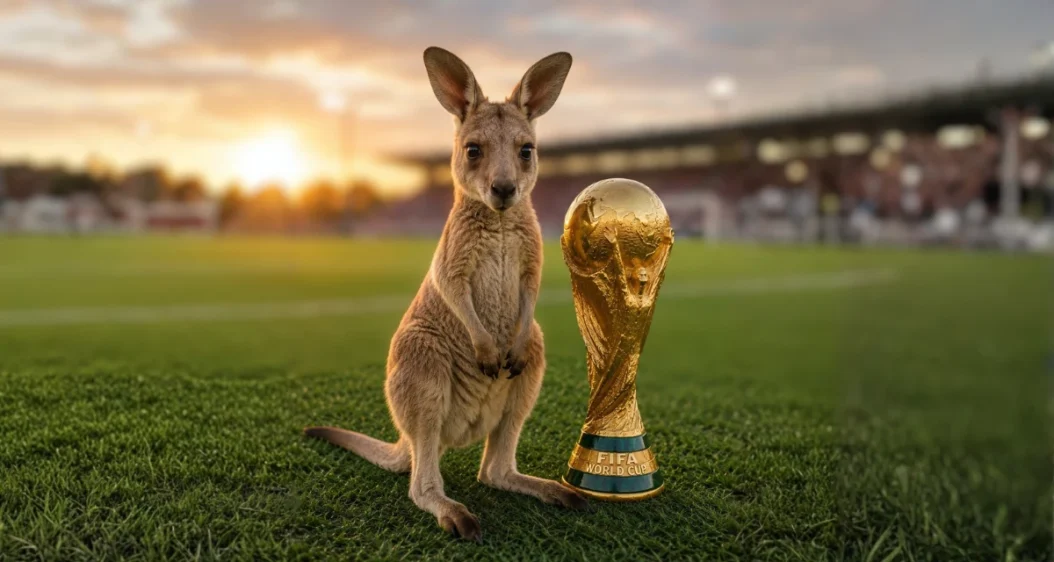
Team Kangaroo Wins World Cup
Shoes made from the marsupials are an endangered species in major U.S. venues hosting matches featuring the world’s elite soccer stars
- Wayne Pacelle
At its start, the 2026 FIFA World Cup featured 48 national teams and 1,248 players on the official tournament rosters.
With the quarterfinals now set after Belgium’s lopsided win over the United States last night in Seattle, perhaps just a single player in the tournament — Junnosuke Suzuki of Japan — laced up soccer cleats made from kangaroo skins.
Just six years ago, when the Center for a Humane Economy and Animal Wellness Action launched the Kangaroos Are Not Shoes campaign, kangaroo leather had been woven into the identity of elite soccer.
Brazil’s Pelé wore classic leather boots in the early 1970s, during the era when kangaroo leather became established as the premium material. Franz Beckenbauer of Germany wore Adidas kangaroo-leather boots. Diego Maradona of Argentina famously wore Adidas kangaroo-skin boots. The still ubiquitous David Beckham wore Adidas Predator models before he retired them. Ronaldinho of Brazil wore Nike Tiempo boots made from kangaroos. Early in his career, Lionel Messi chose Adidas F50 and other models that incorporated kangaroo leather. And Cristiano Ronaldo of Portugal donned early Nike Mercurials that included kangaroo leather.
For more than half a century, the world’s leading athletic brands had promoted kangaroo leather as a premium material for high-performance boots.
So, when we began our campaign in 2020, there were dozens upon dozens of kangaroo-skin shoe models lining store shelves around the world. Generations of players had come to believe that if you wanted to play like the pros, you needed boots made from kangaroo leather.
Many people told me that we had no chance of turning it around, knowing we weren’t asking one company to discontinue a niche product but were challenging product lines at the base of an entire global industry, with perhaps a billion soccer-shoe consumers.
Think about the companies involved. Nike is among the most influential corporations in the world. Adidas has defined soccer culture for generations. Puma, New Balance, ASICS, Umbro, and Mizuno have shaped the footwear choices of hundreds of millions of players in more than 190 nations. Their marketing campaigns have shaped soccer culture and style.
A Market and Moral Revolution
Diadora, prodded with skill by our friends at the animal-protection group LAV in Italy, was the first mover in 2021. Then Puma, in 2023, shared the good news with us that it would stop sourcing kangaroo skins. Nike, the global behemoth in the athletic shoe category, came right on its heels in the same month. Then later that year, New Balance got on board. The only leather used by U.K.-based Sokito in its soccer cleats was kangaroo, and the company shed that species, too.
That left Adidas among the major shoe companies. In 2025, I traveled to Nuremberg to speak before its shareholders and corporate leadership at the company’s annual meeting. During the meeting, CEO Bjørn Gulden announced that Adidas had stopped sourcing kangaroo skins and was exiting production. His remarks drew spontaneous applause from the room.
Within weeks, other companies followed. First, ASICS committed to ending its use of kangaroo leather, and then Mizuno did the same (though its phase-out is maddeningly slow). Umbro followed. One after another, companies that had marketed kangaroo leather for decades concluded that the future belonged to innovative, high-performance materials that didn’t require killing wildlife.
These shifts in manufacturing and marketing left a new moral footprint on this year’s World Cup.
Lionel Messi isn’t wearing kangaroo leather. Neither is Kylian Mbappé. Nor Erling Haaland. Nor Harry Kane. Virtually every superstar in the tournament is competing in boots made from advanced synthetic and other human-made materials.
Children don’t spend hours studying the composition of soccer boots. They watch Messi glide past defenders. They marvel at Mbappé’s speed. They celebrate Haaland’s astonishing goal-scoring and think of him as a modern-day Viking. Then they ask their parents for the boots their heroes wear.
If the greatest players in the world no longer need kangaroo leather to perform at the highest level, why would the next generation think they do?
They won’t.
In an astonishingly short period of time, kangaroo leather has gone from being marketed as indispensable to becoming largely irrelevant.
This is a case study that business schools will examine in the decades ahead about the thousand steps that lead to a marketplace revolution. Awareness drives reflection and reconsideration. Superior innovation overtakes custom and familiarity. And practices once considered permanent begin to fade away.
This change would never have happened without the Center for a Humane Economy, Animal Wellness Action, our NGO partners, animal welfare activists globally, and lawmakers in Congress and in state parliaments in Australia.
My former colleague Mitchell Fox put us on the field of play as our first Kangaroos Are Not Shoes campaign leader. Then he handed off to Natasha Dolezal, who built on that incredible launch. Then Jennifer Skiff, who had been involved since the campaign’s inception, helped us get to this stage. She is our director of international campaigns and had been splitting her time between the United States and Australia.
Our community of advocates did not relent. Film and television director and producer Gavin Polone developed a potent short film in reverse about the kangaroos’ plight — from shoe store to shooting in the Outback of Australia. Donny Moss and Edita Birnkrant, under the banner of Their Turn, led game-changing protests in New York City at flagship stores selling kangaroo-based shoes. Other team leaders led protests in cities from Los Angeles to Boston, from Frankfurt to Sydney.
We had human ingenuity and the instinct for constant improvement on our side. Today’s advanced shoe materials deliver elite performance while leaving wild kangaroos where they belong — in the Australian bush, not wrapped around the feet of soccer players.
History shows that innovation and advocacy can transform business practices. We have seen it with cosmetics testing, the use of elephants and other wild animals in circuses, battery cage confinement, fur farming, and so many other forms of animal use that once seemed so entrenched. We are starting to see cracks in the façade of animal testing, especially with the downfall of Ridglan Farms.
A better, animal-free product can make a once-dominant, animal-based product look like a relic before long.
Team Kangaroo didn’t just win the World Cup.
It helped change the future and footwear of the world’s biggest sport.
Wayne Pacelle, president of the Center for a Humane Economy and Animal Wellness Action, is the author of two New York Times bestselling books, “The Bond” and “The Humane Economy.”